A photo can narrow down which named Moroccan style you're likely looking at, and can flag some obvious signs a rug isn't hand-knotted at all. What a photo cannot do is authenticate a specific rug: confirm its exact age, region, or maker with certainty. This site's own Disclaimer says the same thing about hands-on inspection: individual-rug authentication isn't something a guide can do from a distance, and a photo is an even thinner basis than an in-person look. What follows is what to actually check in the photos you have, or can request, without pretending a checklist settles more than it does.
What the back of the rug shows, if you can get a photo of it
If a listing includes a photo of the reverse side, look there first. Hand-knotted rugs show individual knots on the back, with natural, small irregularities in spacing and tension. No two knots are perfectly identical, because a person tied each one by hand. A machine-made rug, by contrast, typically shows a uniform, mesh-like backing with none of that hand-tied variation, since it was produced by a loom running a repeating mechanical pattern rather than a weaver's hands.
Requesting a back-of-rug photo is a reasonable, low-friction ask of any seller. A seller who has nothing to hide about a piece's construction should be able to provide one without objection; one who resists or has only front-facing photos available is giving you less to work with, which is itself useful information.
Wool, patina, and asymmetry: what a photo can and can't tell you
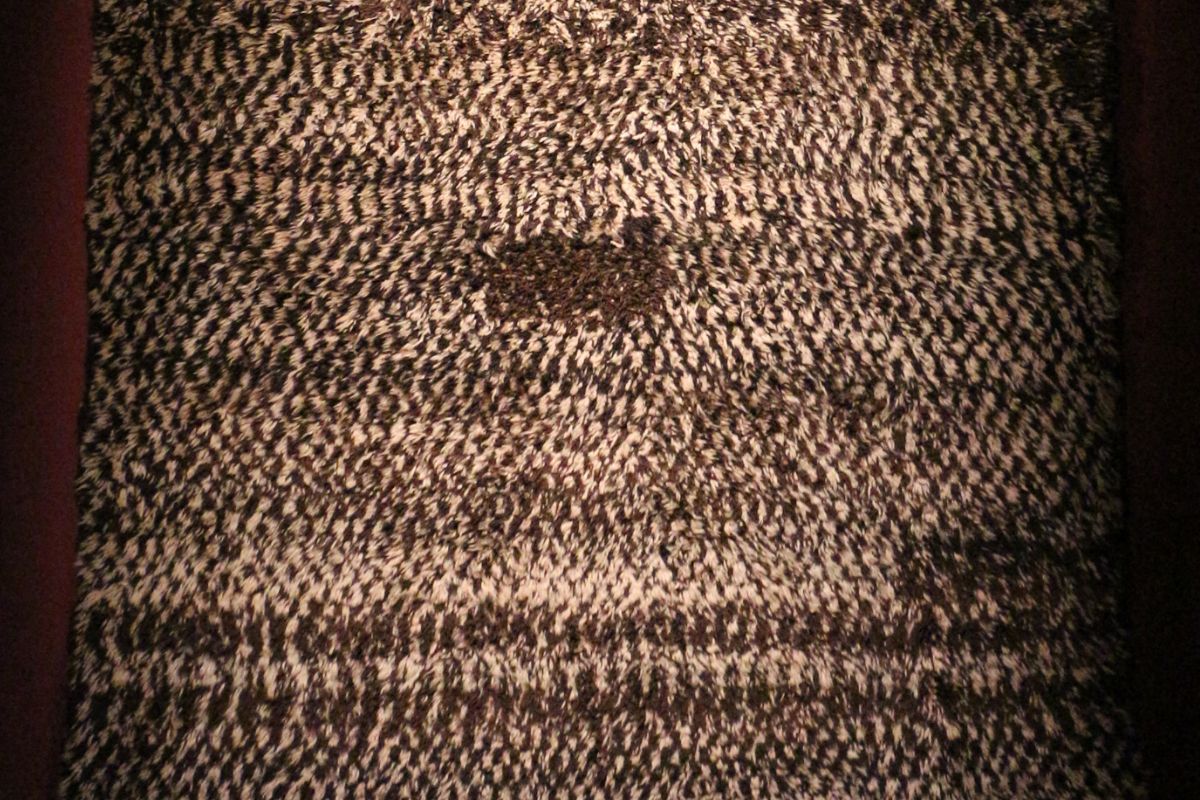
Genuine Moroccan tribal rugs are overwhelmingly wool, sometimes with cotton in the warp threads specifically. In a photo, wool tends to show a certain depth and slight sheen that's hard to fake convincingly, though this is a soft, experience-based read rather than a definitive test. It gets easier to judge the more genuine pieces you've actually seen, and harder to trust from a single low-resolution photo of an unfamiliar piece.
Vintage pieces often show a natural patina: a soft, uneven sheen and slightly muted coloring that develops from age and handling, rather than the flat, uniform coloring of a new synthetic-dye reproduction. Genuine handmade rugs also typically show slight asymmetry: a border that isn't perfectly even, a motif that shifts slightly across the field, which is a normal, expected feature of hand weaving, not a flaw. A rug that looks suspiciously perfect, with mechanically even borders and identical repeating motifs, is worth a second look, though "looks a little too perfect" is a prompt to ask more questions, not proof of anything on its own.
Matching the pattern to a named style
Once you've ruled out the more obvious "not handmade at all" signals, the next useful step is pattern-matching against the named styles this site already covers. An undyed ivory ground with sparse, dark geometric motifs points toward Beni Ourain or its denser relative Beni Mrirt. Bright, freehand, almost sketch-like patterns on a lighter ground point toward Azilal. Warm pinks, magentas, and reds in a denser weave point toward Boujad. A flat, patterned rug with the design visible on both sides points toward Zanafi or Moroccan kilim/hanbel. If none of those match and you're seeing an unusual, saturated palette of aubergine, mauve, tangerine, and ochre in a dense pattern, check Aït Bou Ichaouen or Talsint instead. Working through this site's own style pages this way will get you closer to a likely match than a generic "Moroccan rug" search will.
Other signs a listing photo can reveal
A few additional checks are worth running through before you get to the point of asking the seller anything:
- Fringe. Genuine hand-knotted rugs usually have fringe that is a continuation of the warp threads running through the body of the rug, not a separate strip stitched onto the edge afterward. A fringe that looks glued, serged, or obviously sewn on as a distinct trim is a stronger giveaway of a machine-made reproduction than almost anything else visible in a photo.
- Print versus weave. A genuinely woven pattern has texture and slight color variation within each motif, visible even at a moderate zoom. A printed pattern on a flat or minimally textured backing (common in cheaper decorative "Moroccan-style" rugs sold by mainstream furniture and decor retailers) tends to look flatter and more uniformly colored than a woven equivalent.
- The listing's own language. Terms like "Moroccan-inspired," "Moroccan-style," or "Beni Ourain-style" are often used honestly by retailers selling machine-made reproductions, and are worth reading carefully rather than skimming past. They're a different product category from a hand-knotted piece attributed to an actual weaving tradition, priced and made very differently.
None of these checks is definitive alone, and a confident answer on all three still isn't the same as an expert appraisal. But together they narrow the range meaningfully before you ever have to ask the seller a direct question.
What to ask the seller for, if the photo alone isn't enough
- A photo of the back, for the knot-versus-mesh check above.
- Origin information, even if it's general: region, cooperative, or dealer source, rather than just "Morocco."
- Material confirmation: wool content specifically, and whether any synthetic fiber is blended in.
- A close-up of the pile or weave texture, if the listing photo is low-resolution or heavily filtered, since both can obscure the details above.
A seller who can answer these specifically is giving you real information to work with. A listing that stays vague on all of them after being asked isn't necessarily dishonest, but it is offering you less than what a well-documented piece could provide.
What this guide cannot do
This guide, and any photo-based checklist, has real limits. It cannot confirm a specific rug's age. No photo-based method reliably does that, and this site does not publish age estimates it cannot support with a named source. It cannot confirm which specific tribe or cooperative made an individual piece, even when a general style is identifiable, since named attribution requires documentation this site has repeatedly noted is often missing even from sellers themselves. And it cannot substitute for an in-person, expert appraisal on a purchase where that level of certainty genuinely matters to you. Photos and questions narrow the range of likely answers; they don't settle them.
FAQ
Can I tell if a Moroccan rug is real from a photo alone?
Partially. A photo can flag some signs a rug is machine-made rather than hand-knotted, and can help match it to a likely named style. It cannot authenticate a specific piece's age, region, or maker with certainty.
What's the single most useful photo to ask a seller for?
A clear photo of the back of the rug. It's the most reliable way to check for individual hand-tied knots versus a uniform machine-made mesh backing.
Does asymmetry in the pattern mean a rug is fake?
No, the opposite, generally. Slight asymmetry is a normal, expected feature of genuine hand weaving. A pattern that's mechanically perfect and identically repeating is more worth questioning than one with natural variation.
How do I know which named style I'm looking at?
Compare the palette and pattern density against this site's style pages, undyed and sparse points toward Beni Ourain, bright and freehand points toward Azilal, pink and dense points toward Boujad, and so on. See the full Moroccan rug styles guide for the complete list.
Should I buy a rug based on photos alone, without an in-person look or expert opinion?
For a significant purchase, that's a real risk this guide won't talk you out of taking seriously. Photos and seller questions reduce uncertainty; they don't eliminate it, and this site's own Disclaimer is explicit that it does not offer individual-rug authentication.
Leave a Reply