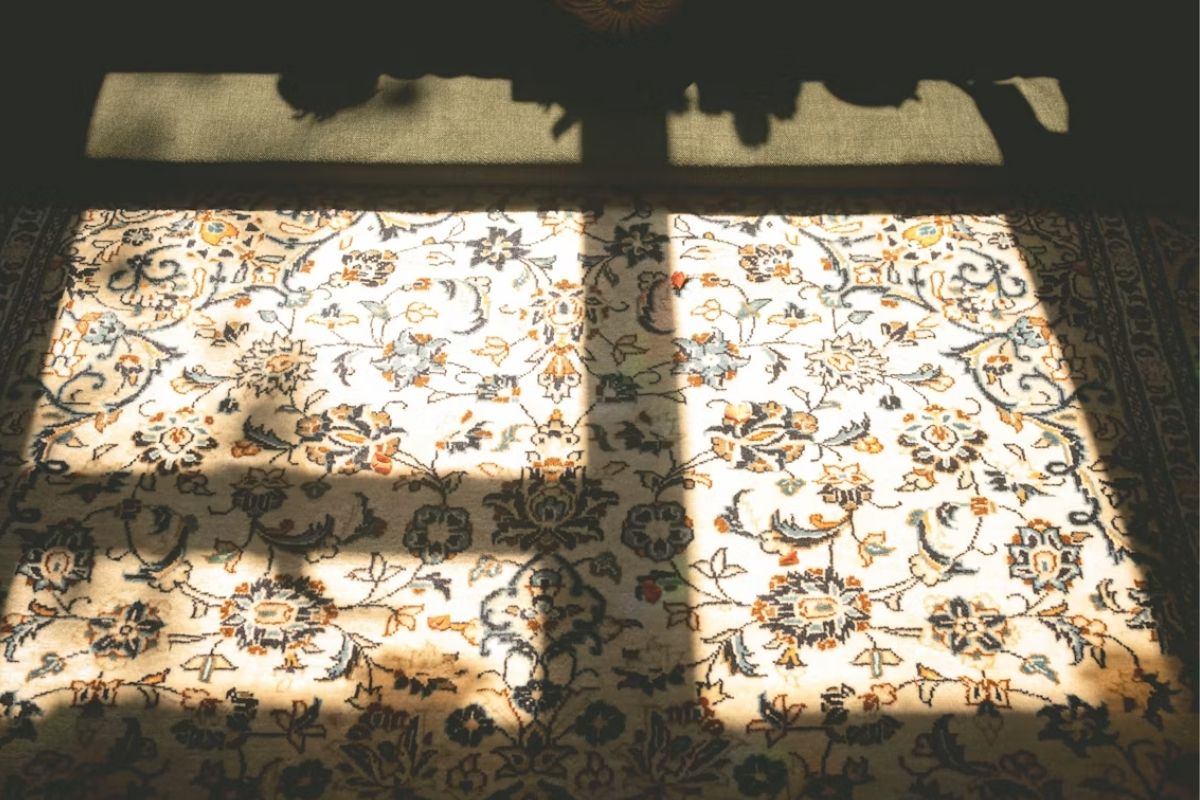
Sunlight fades a wool rug by breaking down the chemical bonds in its dye, not by warming or drying it, and that breakdown is permanent. Rotating the rug end to end every few months spreads the exposure evenly, so it ages as one piece instead of developing a bright strip by the window and a darker one under the sofa. UV-filtering window film or ordinary curtains cut the exposure that causes it in the first place. Nothing sold over the counter reverses fading that has already happened, whatever the label claims, so prevention and rotation are the whole strategy here, not a stopgap before a fix.
What sunlight actually does to a rug's dye
Sunlight is made up of visible light, infrared heat, and ultraviolet radiation, and it is specifically the UV component that does the damage. As reported by flooring-industry and window-treatment sources that study this closely, UV radiation breaks the chemical bonds that hold color to a fiber, which is a different mechanism from heat drying out a rug or foot traffic wearing down pile. That distinction matters because it explains why a rug can fade badly in a cool, air-conditioned room, and why a fading problem cannot be solved by anything that only manages temperature or humidity.
This applies to both natural and synthetic dyes, though the chemistry differs between them. A hand-knotted Moroccan rug is usually dyed with plant sources such as madder root, indigo or henna, or with synthetic dyes depending on the piece, and both families of dye are made of the same kind of chemical bonds that UV light breaks down over time. Neither type of dye is UV-proof. Both simply degrade at different rates depending on the specific dye chemistry, how the wool itself was prepared, a factor covered in what makes rug wool worth paying for, and how much direct exposure the rug actually receives. No wool quality or dye type stops UV breakdown once a rug is genuinely exposed; it only changes the rate.
Why rotation works, and how often to do it
Rotation does not stop fading. It spreads it. A rug that is turned end to end every three to six months, a figure that appears consistently across rug-manufacturer care guidance, receives roughly the same cumulative light exposure across its whole surface instead of concentrating years of direct sun on one strip near a window. The result is a rug that gets gradually and evenly lighter over years rather than one with a sharply visible line between a bleached section and its original color.
This is one of the four habits already covered in how to care for a Moroccan wool rug, and it costs nothing beyond remembering to do it. The same rotation habit matters even when a rug spends part of the year out of the room entirely; see storing a wool rug for a season or a year for what changes once light exposure isn't the immediate concern.
Placement: the real prevention
Rotation manages exposure you can't avoid. Placement reduces the exposure in the first place, and it is the more powerful lever of the two.
- Furniture as a shield. A sofa, bookcase or table positioned between a window and the rug blocks direct beams during the hours they hit hardest, without touching the rug at all.
- Curtains or blinds. A simple curtain closed during peak sun is one of the fastest ways to cut exposure, and side tracks or a bottom seal stop light sneaking in around the edges of a blind, which is where a rug near a window is most vulnerable.
- UV-filtering window film. As reported by window-film manufacturers, a quality film can block a large majority of UV radiation while still letting visible light into the room. This is a permanent change to the window, not the rug, and it protects everything else in the room from the same damage, not just the floor.
- Distance and orientation. Where the layout allows it, keeping a valuable rug out of a room's most direct light path, or accepting that a lighter, more replaceable rug goes in that spot instead, avoids the problem rather than managing it.
Fading vs. dye bleed: the same rug, two different problems
These two get confused constantly, and they are not the same failure. Fading is dye breaking down under light over months or years, and it happens whether the rug is ever wet or not. Dye bleed is color transferring between wet fibers during a spill or a wash, and it happens in minutes, not years. A pale patch by the window is fading. A pink stain spreading from a red section into a cream one after a spill is bleed. Dye bleed and color run: why natural dyes bleed too covers that second problem, including the common seller claim that only synthetic dyes bleed, which is not accurate. Knowing which one you are looking at changes what you do next: fading gets prevented going forward, bleed needs attention the moment it happens.
What can't be undone at home, and what a specialist can sometimes do
There is no product this site can verify that restores original dye chemistry once UV has broken it down. Anything marketed as a fading "repair" applied at home should be treated with the same skepticism this site applies to any uncited claim in this niche: test it on a hidden corner first if you try it at all, and do not expect it to reverse color loss that has already set in.
What a rug restoration specialist can sometimes do is different, and it is a craft decision rather than a product application. On a valuable hand-knotted piece, a specialist may selectively redye a faded section to match the surrounding color, or in more extensive cases reweave the affected area entirely. Both are case-by-case judgments about a specific rug, its dyes and its condition, not a service this site can promise will be available or affordable for any given piece. If a faded area bothers you enough to consider this, the conversation to have is with a rug restoration specialist who works on hand-knotted pieces, not a general carpet cleaner, and the honest first question to ask them is whether the piece is worth the cost of the work.
Telling sun fading apart from ordinary wear
| Sign | Sun fading | Ordinary wear |
|---|---|---|
| Shape | Follows the light, often a sharp line matching a window or door edge | Follows foot traffic, usually a worn path or dulled center |
| Speed | Gradual, over months to years of exposure | Gradual, tied to how much the rug is walked on |
| Texture | Pile texture usually unchanged; only color is affected | Pile can flatten or thin along with any color change |
| Reversible at home | No | Some evening-out is possible with grooming and rotation of traffic patterns |
FAQ
Does rotating a rug really stop fading?
It doesn't stop it, it spreads it evenly across the whole rug instead of concentrating years of exposure on one section, so the rug fades as a whole piece rather than developing an obvious two-tone patch.
Can sun-faded wool rug color be restored at home?
No. UV breaks the chemical bonds that hold dye to the fiber, and no product this site can verify reverses that. A rug restoration specialist can sometimes selectively redye or reweave a faded section on a valuable piece, but that is a craft judgment made rug by rug.
Do UV window films actually help?
As reported by window-film manufacturers, quality films block a large share of UV radiation while still letting visible light through, and they protect a whole room's contents, not just a rug directly under a window.
Is a faded patch the same as a color-run stain?
No. Fading is dye breaking down under light over months or years. Dye bleed is color transferring between wet fibers during a spill or wash, and it happens fast. They need different responses.
How quickly does sun fading actually happen?
It varies with dye type, wool quality and how much direct exposure a spot gets, and this site does not have a verified timeline to give. A rug in a sunroom with unfiltered south-facing windows will show it far sooner than one in a room with curtains and indirect light.
Leave a Reply