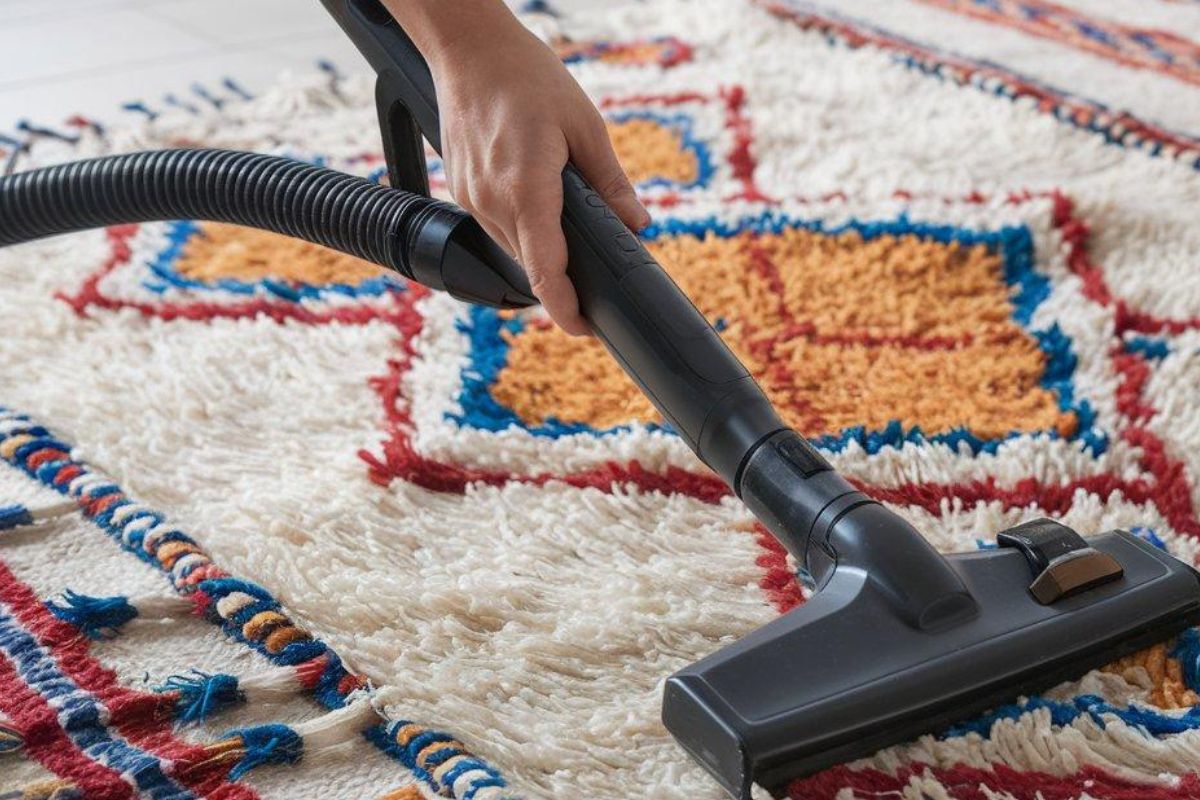
Yes, vacuum it, and often. Switch the rotating brush roll or beater bar off, or use a bare-floor setting, and keep the machine off the fringe entirely. A spinning brush is the most common way owners damage a hand-knotted wool rug at home: it pulls and fuzzes the pile and can rip the fringe out at the ends, which is the one thing on this page you cannot undo. Work with the direction of the pile, without pressing down, and give the areas under furniture more attention than the open floor.
What a beater bar actually does to a hand-knotted pile
A brush roll is designed for tufted wall-to-wall carpet, where the pile is short, uniform, glued into a backing and effectively disposable. It works by agitating fibres to shake dirt loose, which is a reasonable trade on that surface.
A hand-knotted wool pile is a different object. The pile is tied to the foundation knot by knot, it is often longer and looser on a Moroccan rug than on anything the machine was designed for, and there is no adhesive holding anything down. A stiff rotating brush catches individual tufts, works them loose over time, and raises a fuzzed surface where the fibres have been broken rather than lifted.
The care guidance from rug specialists and manufacturers converges on the same instruction: turn it off, or use a setting that lifts it away from the pile. This is one of the few points in the whole niche where sellers, cleaners and manufacturers all agree.
If your vacuum's brush roll cannot be switched off
This is most people's actual situation, and the advice to "turn off the beater bar" is not much help if there is no switch. Options, roughly in order of preference:
- Use the hose and a plain suction head. Every upright has one. A bare-floor or upholstery attachment has no rotating parts and is completely safe on wool. It is slower and it is the correct tool.
- Raise the height setting to its maximum. If your machine has a pile-height adjustment, the highest setting lifts the brush away from the surface so it barely contacts the pile.
- Use a canister or cylinder vacuum with a plain floor head if you have one in the house.
- Vacuum the rug from underneath occasionally. Turning a rug over and vacuuming the back on a hard floor drives grit down out of the pile onto the floor, where you then sweep it up. This is genuinely effective and it is not something most people think to do.
This site does not review, rank or recommend vacuum cleaners, and there is no need to buy anything: the attachment you need almost certainly came in the box.
Direction, pressure and how often
Direction. Run the head with the pile rather than against it. Brush a hand across the surface and you will feel which way it lies: one direction is smooth, the other resists. Going against the lay opens the pile and works grit deeper in.
Pressure. None. Let the suction do the work. Pushing a head down into a long pile compresses it and achieves nothing except wear.
How often. Regularly rather than intensively. General care guidance points to something like weekly for a rug in normal use, more in a traffic path and less in a quiet room, and this guide will not put a firmer number on it than the sources support. Frequent light vacuuming beats occasional aggressive vacuuming, because the damage grit does is abrasive and cumulative: sand and dust work down to the base of the pile and cut the fibres from below every time someone walks on it.
That is the real argument for vacuuming a wool rug often. You are not removing surface dust for appearance, you are removing an abrasive.
The fringe, which is where the irreversible damage happens
Fringe is not decoration. On a hand-knotted rug it is the warp threads of the foundation, emerging from the body of the rug. Tear it off and you are pulling at the structure.
A rotating brush catches fringe, wraps it, and rips it. It happens in a second and it cannot be undone at home; replacing or reweaving fringe is specialist work.
So: keep the vacuum head off the fringe entirely. If the fringe needs cleaning, use the hose held slightly above it, or comb it gently with your fingers. Never run a powered head across it, and never let a robot vacuum near the ends of a fringed rug.
Why the parts under the furniture matter most
The instinct is to vacuum the open floor where the dirt shows. The parts that actually need it are the ones nobody walks on.
Carpet moth larvae feed on wool and avoid light and disturbance, so they settle under sofas, along edges, behind doors, and on the underside of a rug that has not moved in two years. Damage there can be well advanced before anyone notices, because nothing about the visible part of the rug looks wrong.
Moving furniture and vacuuming underneath a few times a year is the cheapest pest prevention available, and it doubles as the inspection. While the corner is up, look at the base of the pile for fine webbing, small pale tubular cases and sandy grit. Carpet moths: how to tell if you have an active infestation covers what those signs mean.
One related question this answers: if vacuuming brings up a lot of loose fibre from a new rug, that is usually normal shedding rather than damage. Why your new wool rug sheds explains the difference, and what it means when it is not shedding.
For the whole routine see how to care for a Moroccan wool rug, and before putting any product on the rug, cleaning products that quietly destroy wool. If you are unsure whether your rug is hand-knotted in the first place, what the back of the rug shows settles it.
FAQ
Can I vacuum a wool rug with a normal vacuum cleaner?
Yes, with the rotating brush roll switched off or the height raised to maximum, and using a plain suction head where possible. Keep it off the fringe.
Will a beater bar ruin my rug?
It will not ruin it immediately, but repeated use fuzzes the pile by breaking fibres, and it can tear the fringe out in one pass. The fringe damage is the part that cannot be fixed at home.
How often should I vacuum a wool rug?
Roughly weekly in normal use, more in a traffic path. Frequent light vacuuming matters because grit at the base of the pile is abrasive and cuts fibres every time the rug is walked on.
Should I vacuum the back of a wool rug?
Occasionally, yes. Turning it over on a hard floor and vacuuming the back drives grit out of the pile onto the floor, where you can sweep it up. It is a genuinely useful habit.
Can I use a robot vacuum on a hand-knotted rug?
Keep it away from fringed ends, where the rotating parts can catch and pull. On the body of a low-pile rug it is less of a concern, but a plain suction head remains the safer tool.
Leave a Reply