The question is usually "can I put this rug in the basement," and the honest answer needs one fact first, because the fact is what makes the answer counterintuitive.
Wool holds a great deal of water without feeling wet. The Woolmark Company states it directly: "Wool can absorb up to 35% of its weight before feeling wet and clinging to the skin." The International Wool Textile Organisation gives the same figure independently, describing wool as absorbing up to 35% of its own weight in moisture.
That property is why wool is comfortable to wear. On a floor, in a damp room, it is the whole problem. A hand-knotted rug in a humid basement can be a third of the way to soaked and feel perfectly normal underfoot, for months, while everything that goes wrong with damp wool goes wrong.
What actually goes wrong, in order
Four things, and they arrive in a sequence.
Odor first. Mildew smell is the earliest signal and the one people notice. By the time a rug smells, moisture has been sitting in it for a while.
Then mold. The US Environmental Protection Agency's guidance is blunt about what happens to absorbent things: "Absorbent or porous materials, such as ceiling tiles and carpet, may have to be thrown away if they become moldy." That sentence is about carpet in general and it applies with more force to a one-off hand-knotted piece, because there is no replacement to buy.
Then moths, and this is the part that surprises people. A quiet, undisturbed, humid room is close to ideal conditions for carpet moth larvae, and a rug in a basement is by definition a rug nobody walks on or vacuums. How to tell whether an infestation is active is worth reading before a rug goes anywhere out of daily sight, not after.
Then dye movement. The WoolSafe Organisation notes that high alkalinity can cause "pigment bleeding in natural Berbers" among other damage. Sustained damp is not the same as an alkaline cleaner, but the general rule holds: dye that stays wet for long enough eventually moves.
The number worth writing down
The EPA's recommendation for indoor humidity is specific and it is the one figure to act on: "keep indoor humidity below 60 percent (ideally between 30 and 50 percent) relative humidity."
Measure it rather than judging it. A room can sit above 60 percent and feel fine, particularly a cool one, and the difference between a room at 45 percent and a room at 65 percent is invisible and decisive. This is the single check that answers the question on this page, and it costs almost nothing to make.
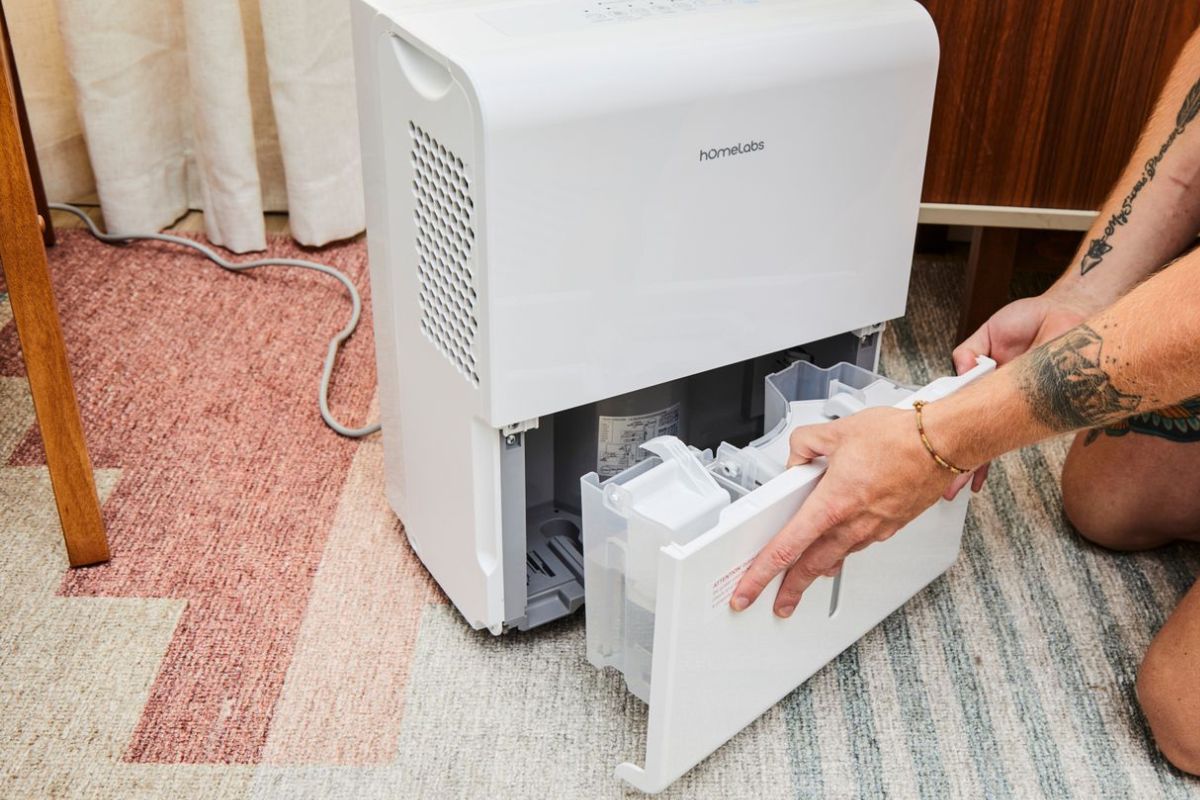
We are not going to recommend a meter or a dehumidifier. We have tested none, and the reading matters far more than the instrument that produced it.
The 24 to 48 hour rule
If a rug does get wet, the EPA's window is the thing to remember: "It is important to dry water-damaged areas and items within 24-48 hours to prevent mold growth."
That is a short window, and it is shorter than it sounds for a hand-knotted wool rug, because of the 35 percent problem at the top of this page. A rug whose surface is dry can have a wet foundation. Check the back, and check the floor underneath.
Getting a large wool rug genuinely dry inside two days is difficult in a room that was damp enough to wet it in the first place. That is not a reason to hurry it with heat. Heat felts wool and sets stains, and the reasons washing a wool rug at home usually goes wrong are mostly reasons about water and drying rather than about soap.
The rooms, ranked honestly
Basements: no, unless you have measured the humidity and it sits in the EPA band year round, and the floor has never been wet. Most basements fail at least one of those. This is the room the question is usually about and the answer is usually no.
Bathrooms: no. Repeated wetting plus poor ventilation, and the wetting is scheduled rather than accidental.
Unheated conservatories and sunrooms: no, for humidity swings as much as for the sun, which is its own separate damage.
Garages, sheds and lofts: not for storage. The instinct to roll a rug up and put it somewhere out of the way is exactly how rugs are lost, and it is lost to the same four failures above with nobody present to notice the first one. Storage has a right method and it is worth doing properly.
Ground floors over a crawl space: check. These look like ordinary rooms and sometimes carry ordinary-room humidity and sometimes do not.
Kitchens and hallways: a different question, about splashes and traffic rather than about ambient humidity, and not this page's subject.
If the rug is already in a damp room
Three moves, in order of how much they matter.
Move it. Everything else is a mitigation of a decision you can simply reverse. A rug is not fixed to the floor.
If it stays, lift it and look at the back. Monthly. The underside and the floor beneath it tell you the truth well before the surface does, and this is a two minute check that catches every failure on this page while it is still nothing.
Keep air moving under it. A rug lying flat against a cool floor in a humid room is the worst version of the arrangement, because the moisture has nowhere to go.
And do not respond to a musty rug by cleaning it. Adding water to a rug whose problem is water is the most common wrong move here. Dry it, move it, then decide about cleaning.
What mildew smell means and what it does not
A musty smell is not proof of mold, and its absence is not proof of no mold.
What it does prove is that the rug has been damp for a while, which is the actionable part. Treat the smell as a reading on a meter rather than as the problem itself.
Fresh wool has its own smell, particularly when it is new or when it gets warm, and it is not mildew. Why a new wool rug behaves the way it does in its first months covers the ordinary version of new-rug behavior that people sometimes mistake for a fault.
The line this page does not cross
Why a room is damp is a building problem, not a rug problem. Waterproofing, drainage, ventilation and subfloors are real work with real methods and none of it is our subject, so we are not going to improvise it here.
Mold that is already growing is a health question, and the EPA guide linked above is written for exactly that situation by people whose job it is. Read theirs, not ours.
The part worth remembering
Wool hides water, and a damp room destroys a hand-knotted rug slowly enough that nobody intervenes in time.
Measure the humidity, aim for the EPA's 30 to 50 percent, dry anything wet inside 24 to 48 hours, and lift the rug once a month to look underneath. If the room cannot hold that band, the rug belongs in a different room, and no product changes that. The rest of the routine is in the main care guide.
Leave a Reply