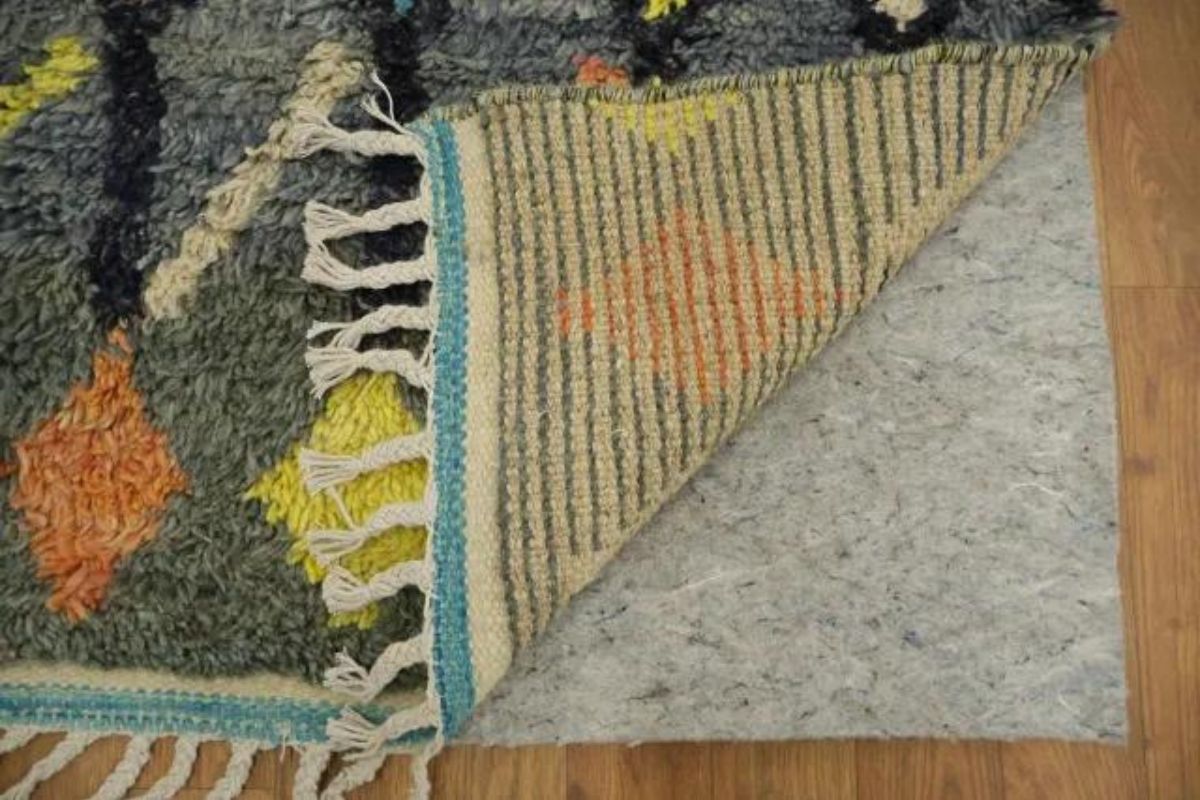
A rug that shifts underfoot or curls at the edge is a documented fall hazard, not just a decor annoyance. Peer-reviewed research published in the Journal of Injury and Violence Research (Rosen, Mack and Noonan, 2013) estimated roughly 38,000 emergency-department visits a year in the United States among adults aged 65 and older for falls associated with rugs and carpets. A non-slip pad matched to your floor type is the first fix for a rug that shifts as a whole. Rug tape or corner grippers handle edges a pad alone doesn't stop. Silicone caulk anchors a rug close to permanently and can be hard to remove later. Which one is right depends on how often you plan to move the rug and what floor is underneath it, and this guide names no single product as the answer.
Why this is a safety question, not a decor one
It is worth stating the evidence plainly, because most pages that rank for this treat it as a mild inconvenience. The 2013 study, published in the Journal of Injury and Violence Research and affiliated with CDC injury-prevention research, put the annual figure at approximately 37,991 adults 65 and older treated in U.S. emergency departments for falls associated with rugs (45.8% of the cases) and carpets (54.2%). Women accounted for 80.2% of those injuries, and the most common home locations were the bathroom, at 35.7%, followed by the bedroom. The same research identified loose, unsecured rugs and curled carpet edges as recognized environmental hazards, and separately, the Consumer Product Safety Commission has reported that floors and flooring materials are involved in more than two million fall injuries a year across all age groups, not just older adults.
None of this means every rug in every home is dangerous. It means a rug that visibly shifts, bunches, or has a curled corner is a specific, fixable hazard rather than a cosmetic quirk, and it is worth treating it that way rather than living with it because it hasn't caused a fall yet.
What actually anchors a rug: options compared
| Method | How it works | Best for | Watch for |
|---|---|---|---|
| Non-slip rug pad | Friction between pad and both surfaces resists sliding | Most rugs, most floors, and reversible | Cheap rubber or vinyl pads can damage a hardwood finish; see rug pads for a wool rug for the material question in full |
| Rug tape or corner grippers | Adhesive strips at edges and corners, not under the whole rug | Curled corners and edges on a rug that otherwise sits still | Can leave residue on some finishes when removed; test a hidden spot first |
| Silicone caulk applied to the backing | Bonds the rug's underside directly to the floor in dots or lines | A rug that will stay in one place indefinitely | Semi-permanent; removing it later can be difficult and can mark the floor |
| Furniture anchoring | Furniture weight on the rug's edges resists movement | Rugs already positioned under a sofa, bed or table | Doesn't help open sections of rug with nothing sitting on them |
| Velcro-style strips | Reusable hook-and-loop pieces on rug and floor | A rug moved or lifted occasionally for cleaning | Weaker hold than caulk; needs reapplication over time |
Reversible vs semi-permanent: matching the method to the rug
The honest question to ask before choosing is how likely you are to move this specific rug again. A pad or tape is fully reversible and does nothing to the rug itself, which makes it the lower-risk starting point for a hand-knotted piece you might rotate, resize the room around, or eventually sell. Caulk is closer to a permanent decision: it holds extremely well, but it bonds to the rug's backing and to the floor, and undoing that later is genuinely difficult. For a rug you are confident will stay exactly where it is for years, that trade-off may be worth it. For a hand-knotted rug you intend to rotate for even wear, as covered in how to care for a Moroccan wool rug, a permanent adhesive is working against the maintenance routine, not with it.
A rug that lies flat and stays anchored is also easier to vacuum correctly, since a machine can be run in one direction without catching a curled edge or a shifting corner. Vacuuming a wool pile rug without damaging it covers the technique itself, and it works best on a rug that isn't also fighting to slide out from under the machine.
The edges matter as much as the middle
A rug that lies flat and doesn't visibly slide can still curl at a corner or an edge, and the fall-injury research above names curled edges specifically as a recognized hazard, separate from a whole rug sliding across the floor. A pad under the center of a rug does very little for a corner that has started to lift. Corner grippers or a short length of rug tape at each curled point address this directly, and it's worth checking the edges even on a rug you've already anchored with a pad, since the two problems don't always travel together.
What to avoid doing to a hand-knotted piece specifically
Anchoring methods that permanently alter the rug's backing, primarily caulk applied in a heavy or continuous line, put a modification on an object that has no factory backing to begin with. A hand-knotted rug's underside is the reverse of the knots themselves, and a heavy adhesive layer there is harder to reverse than on a machine-made rug with a manufactured backing already covering that surface. If you're not certain the rug's position is permanent, start with a pad or corner tape, and treat caulk as the last option rather than the first, particularly on an older or naturally dyed piece where you cannot easily tell how it will respond to an adhesive until it's already applied.
FAQ
Why do rugs slip on hardwood floors specifically?
Smooth, finished wood offers little friction against a rug's backing, especially a hand-knotted rug with no rubberized or textured underside of its own, which is why hardwood shows this problem more visibly than carpet does.
Is a slipping rug actually dangerous, or is that overstated?
It's a documented risk, not an exaggeration. Peer-reviewed research (Rosen, Mack and Noonan, 2013, Journal of Injury and Violence Research) estimated roughly 38,000 annual emergency-department visits among adults 65 and older for falls involving rugs and carpets, with loose rugs and curled edges named as specific hazards.
What is the best way to stop a rug sliding without damaging the floor?
A non-slip pad made of felt and plasticizer-free natural rubber is the option most consistently described as floor-safe. Rug pads for a wool rug covers the material question and what to check before buying one.
Can I use double-sided tape under a whole rug instead of a pad?
It's possible for small rugs, but tape under a large area is harder to apply evenly and can leave more residue across a bigger surface than a pad would. Corner and edge tape is generally the better use of it, alongside a pad for the rest of the rug.
Do non-slip pads work on tile as well as hardwood?
The friction mechanism works on most hard, smooth floors, though the material best suited to tile isn't always identical to the material best suited to a finished wood floor. Check a pad's own labeling for which floor types it's rated for.
Leave a Reply