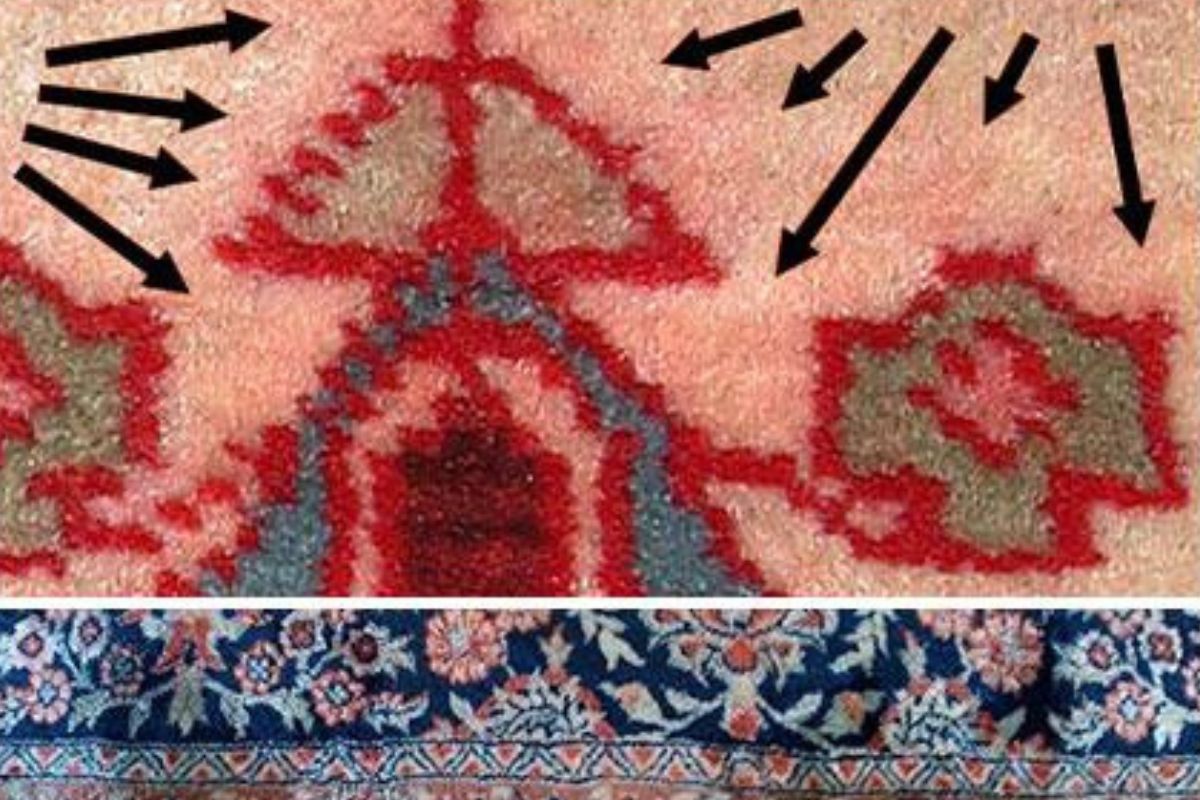
Wool rug color bleeding happens when dye that was never firmly bonded to the fiber dissolves in water and moves somewhere else, usually a red or indigo traveling into a cream field. It is a dye-fixing failure, not evidence that you were sold a fake. Natural dyes bleed too. What decides how much of your rug you get back is not the dye's origin, it is timing: dye that is still wet can often be flushed out, and dye that has dried into the pile is specialist work. Heat, alkaline cleaners and pet urine are the three things that most often start it.
What wool rug color bleeding actually is, and three things it is not
Bleeding is wet migration. Water dissolves loose dye, the dye travels with the water, and it lands in a neighboring color where it dries in place. It needs moisture to happen, which is why it so often appears during or just after a cleaning attempt.
Three problems look similar and are not the same thing:
- Crocking is dry color rub-off. If color comes away on a white sock or a bare foot with no water involved, that is surface dye or an applied color treatment, not a wet-fastness problem.
- Fading is light damage. The color leaves and goes nowhere. If one half of the rug has gone pale and no other color has darkened, read what sunlight does to a rug and what cannot be undone instead.
- Wicking is an old spill traveling back up the pile as a rug dries. The mark reappears in the same spot rather than spreading into a new color.
Naming the right one matters because the response differs. Only bleeding is a race.
Triage: what state is the bleed in
Organize this by state rather than by cause, because state is what determines how much time you have.
| What you are looking at | What it usually means | What is realistically recoverable |
|---|---|---|
| Wet right now, color visibly moving | Loose dye is in solution and still spreading | The most recoverable state there is. Blot, stop adding liquid, and get help the same day |
| Dried after a spill or a home wash | The migrated dye has bonded where it landed | Often improved by a professional, rarely erased. Christopher's Area Rug Cleaning describes most cases as significantly improved with some residual discoloration possible |
| Only where a pet has urinated | Alkalinity from the urine has attacked the dye locally | The rug may be perfectly colorfast everywhere else. Treat it as a contamination problem first |
| Color rubs off dry, nothing is wet | Crocking, not bleeding | A cleaning and finishing question, not an emergency |
| It happens every time the rug gets damp | The dye was never properly fixed | Manage it as a permanent constraint on how the rug is cleaned |
The counterintuitive line in that table is the first one. Most people photograph the problem, search, read, and then act. On a wet run, the reading time is the damage.
The chemistry that decides everything you do next
Wool is dyed with acid dyes, and the bond depends on the fiber being acidic. Writing in the cleaning-industry trade publication Cleanfax, IICRC-approved instructor James "Jim" Smith sets out the numbers: finished wool carpet is acidic in pH, often in the range of pH 4 to 5.5, and wool changes its polarity at pH 5.5 because that is its isoionic point. Above pH 5.9, he writes, color loss is more likely to occur. He also notes that some chemical manufacturers once formulated wool detergents at pH 6.5 and inadvertently caused dye bleeding.
That is the whole mechanism in one paragraph, and it explains the advice you see everywhere without a reason attached. Alkaline products push wool past the point where it holds its own dye. It is also why WoolSafe exists: the body accredits cleaning products its laboratory testing shows do not harm wool carpets and rugs on color fastness, rapid resoiling, fiber damage or odor. On a wool rug, a WoolSafe mark is a checkable claim rather than a marketing word, which is more than most bottles offer. Our guide to the cleaning products that quietly destroy wool goes through the categories in a normal cupboard.
Why natural dyes bleed too
The claim that natural dyes do not run, so a color run proves a synthetic dye and therefore a fake, is repeated across rug seller pages. It is not true.
A natural dye is fixed to wool with a mordant, and a properly mordanted natural red stays put. A badly mordanted one bleeds. So does a poorly fixed synthetic. Age works against the natural dye rather than for it, because natural dyes grow less stable with oxidation and exposure, which is why the rug most likely to be harmed by a careless wash is often the older and more valuable one. The dye plants reported in Moroccan cooperative weaving, henna, pomegranate peel, saffron and indigo in the Taznakht reporting by Africanews and The Arab Weekly, carry no immunity here.
If your real question is what the run says about the rug's authenticity, the short answer is nothing, and the long answer is in why bleeding proves nothing about natural versus synthetic dye.
The three things that make a colorfast rug start bleeding
A rug that has been stable for years can bleed the first time one of these arrives.
Heat. The rug-care site Rug Chick makes the point that even a colorfast dye treated with a dye-stabilizing solution can bleed if that is combined with high temperature during cleaning, or with high-alkaline cleaning solutions. Hot water is not a stronger clean on wool, it is a different and riskier one.
Alkaline residue. The same source describes residue left behind by in-home carpet cleaning machines creating an alkaline environment in the pile that works on acid dyes over time. The damage is not always visible on the day.
Pet urine. Urine starts acidic and turns alkaline as it sits, and Rug Chick describes repeat pet stains causing permanent dye damage for exactly that reason. This is the most common way an otherwise sound rug develops a local color run, and the odor problem underneath it has to be dealt with before anyone works on the color.
The home fixes that make a color run permanent
This is where a recoverable problem usually becomes a permanent one.
Chlorine bleach. Clorox's own guidance on bleaching wool is that liquid chlorine bleach is absolutely not recommended, even a dilute solution. That is the manufacturer saying it, not a rug site.
Mixing anything. Before you reach under the sink at all: public health guidance, including the Washington State Department of Health, is that bleach combined with an acid produces chlorine gas and bleach combined with ammonia produces chloramine gas. Both are toxic to breathe. Nothing about a rug is worth that.
Oxygen bleaches and general-purpose cleaners. Most are alkaline, which is the condition the chemistry above says to avoid.
Vinegar dilutions from the internet. Acid is the condition under which wool bonds acid dye. Poured over color that has already migrated into a cream field, an acid rinse acts on that migrated dye too. Professionals do use controlled acidic chemistry here, with testing and equipment behind it. This guide publishes no dilution ratio, no water temperature and no dwell time, because no named authority publishes one for home use and an invented number is worse than none. The most-cited page on this query gives all three with no source at all.
More water. Over-wetting dissolves more dye. Folding or stacking a damp rug transfers color between surfaces. If a wash is what started this, whether you should wash a wool rug at home is the honest version of that question.
The colorfastness test, and what it does not tell you
Before any liquid goes on a wool rug, test each major color separately. Dampen a clean white cloth with cool water, press it firmly onto one color, hold it there briefly, lift it, and look for color transfer. Any color on the cloth means that color will move if the rug gets wet. Repeat for every color in the rug, and test near an edge or under furniture rather than in the middle.
A professional does a version of the same thing. Colorfastness testing sits inside the pre-cleaning inspection described by ANSI/IICRC S100, the industry standard for professional cleaning of textile floor coverings, which is why a competent rug cleaner tests before quoting rather than after.
What the test does not tell you is how the rug will behave under a cleaning product, at temperature, or after years of alkaline residue. A pass means "not obviously fugitive in cool water today", nothing more.
When to stop, and who to call
Stop and call a professional rug cleaner if any of the following is true: the dye is wet and still moving, the rug is hand-knotted and old or valuable, the bleed followed a pet accident, or a home attempt has already been made. Ask specifically for a rug cleaner who works off-site in a wash plant, and ask whether they hold IICRC rug-cleaning certification or work with WoolSafe-accredited products. Both are things you can check.
Christopher's Area Rug Cleaning describes flushing the affected area with a dye-stabilizing solution while the rug is still damp, within a few hours, and describes a wider range of outcomes once it has dried. Speed is the variable you control. Everything else is theirs.
Atlas Rug Guide does not clean rugs and cannot tell you what a specific piece will survive. What we can say is where the decision stops being a homeowner's.
Preventing the next one
Test each color before the rug ever gets wet, and write down what you find. Blot spills straight down with a white cloth instead of rubbing, working from the outside in, which is covered properly in what to do in the first five minutes after a spill. Keep alkaline products and hot water off the rug. Dry it flat and fully, never folded. Deal with pet accidents the day they happen rather than the week after. The rest of the routine that keeps a hand-knotted piece stable is in the Moroccan wool rug care guide.
A rug that bleeds is not a ruined rug and it is not a fake one. It is a rug with a cleaning constraint, and the constraint is manageable once you know it is there.
FAQ
Does a color run mean my Moroccan rug is fake?
No. It means the dye was not firmly fixed to the fiber. Natural and synthetic dyes both bleed when they are badly fixed, and properly mordanted natural dyes do not. The run tells you how to clean the rug, not where it came from.
Can I fix wool rug color bleeding myself?
If the rug is wet and the dye is still moving, blotting with a dry white cloth and stopping all liquid is the useful thing you can do. Beyond that, home attempts with bleach, oxygen cleaners or unmeasured acid rinses are the main reason recoverable runs become permanent. This guide does not give a home formula because no named authority publishes one.
Why did my rug bleed only where the dog had an accident?
Pet urine turns alkaline as it sits, and alkalinity loosens the bond between wool and acid dye. Rug Chick describes repeat pet stains causing permanent dye damage for that reason. The rest of the rug can be perfectly colorfast.
Is hot water safe on a wool rug?
Treat it as not safe. Heat combined with alkaline cleaning solutions is named by rug-care specialists as a trigger for bleeding even in dyes that tested colorfast. Cool water and a product accredited for wool is the low-risk path.
Can a dried color run be removed completely?
Sometimes it is significantly improved, and sometimes some discoloration remains. Christopher's Area Rug Cleaning describes both outcomes. Anyone promising complete removal on a dried run before seeing the rug is promising something they cannot know yet.
Leave a Reply