Blog

  • Morocco’s Antique Rug Export Permit Rule, Explained

    Morocco’s Antique Rug Export Permit Rule, Explained

    Two separate laws sit at either end of this journey and they are constantly confused. At the Moroccan end, genuine antiques, described as items over 100 years old, require an export permit from the Ministry of Culture under Morocco's heritage legislation. At the United States end, a bilateral cultural property agreement restricts the import of specific categories of Moroccan archaeological and ethnological material. Reading both carefully, an ordinary Amazigh wool pile rug of the kind this site covers appears to fall outside the US restriction, and outside Morocco's permit rule too unless it is genuinely a century old. Most are not.

    Why this page exists

    Buyers hear "cultural property law" and either panic or ignore it entirely. Sellers rarely raise it at all. The result is a question with real legal exposure attached and almost no accurate information available in the niche.

    This page is not legal advice, gives no opinion on any specific rug, and cannot tell you what applies to your purchase. What it does is name the actual instruments, with dates, so you know what you are dealing with and who to ask.

    Morocco's side: the 100-year permit

    Morocco's framework is Law No. 22-80, on the conservation of historic monuments and sites, inscriptions, works of art and antiquity. Under it, genuine antiques, described in the sources consulted as items over 100 years old, are subject to export licensing and require a permit from the Ministry of Culture.

    For contemporary craft, and that includes essentially all rugs made in recent decades, there is no export restriction. You buy it, you take it, and nothing else applies.

    The obligation falls at the point of export, from Morocco. If you have bought something genuinely a century old, the paperwork is not optional and it is not something to sort out at the airport. The seller should be able to speak to it, and if a seller is claiming that kind of age while shrugging at the paperwork, those two positions do not sit together.

    The United States' side: the cultural property agreement

    The United States and Morocco entered into an agreement under the Convention on Cultural Property Implementation Act, and import restrictions on categories of Moroccan archaeological and ethnological material were imposed in January 2021. They were extended effective 14 January 2026 and now run through 14 January 2031, per US Customs and Border Protection's Federal Register notice.

    Material on the Designated List may not be imported into the United States unless it is accompanied by documentation certifying that it left Morocco legally.

    Why an ordinary Moroccan wool rug appears to sit outside both

    This is the part worth reading closely, because the Designated List is specific and almost nobody in this niche has looked at it.

    The archaeological category covers material dated roughly from one million BC to 1750 AD. It does include textiles, and the textiles it describes are linen, hemp and silk cloth used for burial wrapping, shrouds, garments, banners and sails. A twentieth-century Amazigh wool pile rug is none of those things, in neither material nor use nor date.

    The ethnological category covers architectural elements, manuscripts, and ceremonial and ritual objects of Islamic culture from the Saadian and Alaouite dynasties, roughly 1549 to 1912. Again, a domestic wool floor rug woven for use in a household is not an architectural element, a manuscript, or a ceremonial or ritual object, and the great majority of rugs in the market postdate 1912 in any case.

    So on the face of the list, the US restriction is aimed at a different class of object entirely. This guide reports that as a reading of the published categories, not as a legal opinion, and the list can be amended. If you are importing something you believe is genuinely old or unusual, check the current Designated List and, if there is any doubt, ask a customs broker or a lawyer rather than this page.

    Readers outside the United States: this restriction is US-specific. Your own country will have its own rules on cultural property imports, and they are not the same. Morocco's export rule, on the other hand, applies to everyone leaving Morocco.

    What to do if a seller genuinely claims 100-plus years

    This is where the legal question loops back into the commercial one that runs through the rest of this site.

    If a seller tells you a rug is a century old or more, that claim has consequences. It means an export permit is required, and it means the seller should be able to produce or arrange documentation. Ask for both, in writing, on the invoice.

    What usually happens next is instructive. The age claim softens. As what "vintage" actually means on a Moroccan rug listing sets out, the vocabulary in this trade is loose, unregulated and frequently detached from actual age, and the Anou Cooperative has reported that a great deal of "vintage" Moroccan stock is new and treated to look old, covered in how new rugs are made to look old.

    So the permit question is a useful test of a seller as well as a legal step. A seller who will put a hundred-year claim in writing and handle the permit is telling you something real. A seller who will not do either has answered a different, more important question. Is my Moroccan rug authentic covers what can and cannot be established about age.

    If the rug really is that old, treat the purchase accordingly: proper documentation, a proper declaration, and professional advice. Customs, duty and declared value covers the arrival end, and shipping a rug home from Morocco the journey.

    What this guide is not

    It is not legal advice. It does not interpret the law for your circumstances, it does not tell you whether your rug is covered, and it does not offer any way to reduce or avoid a legal obligation.

    These laws exist to protect cultural property, including the heritage of Amazigh communities whose work this site writes about, and that is a good reason for them rather than an inconvenience. Where a permit is required, the answer is to get one.

    For anything genuinely old, ask the Moroccan Ministry of Culture, your own national customs authority, and a qualified lawyer or customs broker. Sources named on this page were read on 2026-08-04; laws and designated lists change, so check the current versions.

    FAQ

    Do I need a permit to take a Moroccan rug out of Morocco?
    Only if it is a genuine antique. Morocco's heritage law requires an export permit from the Ministry of Culture for items over 100 years old. Contemporary craft, which covers almost all rugs on the market, carries no export restriction.

    Can I bring a Moroccan rug into the United States?
    Ordinary wool rugs are not what the US-Morocco restriction targets. The Designated List covers archaeological material up to 1750 AD, whose textiles are described as linen, hemp and silk burial cloth and similar, and ethnological material such as architectural elements, manuscripts and ceremonial objects from 1549 to 1912. Check the current list if your piece is genuinely old or unusual.

    How long do the US import restrictions last?
    They were imposed in January 2021 and extended effective 14 January 2026, running through 14 January 2031, per CBP's Federal Register notice. They can be extended again.

    My seller says the rug is 100 years old. What should I ask for?
    The age claim in writing on the invoice, and the export permit. If a seller will not provide either, treat the age claim as unsupported rather than treating the paperwork as optional.

    Does this apply if I am not American?
    Morocco's export rule applies to everyone leaving Morocco. The import restriction described here is US-specific, and your own country will have its own cultural property rules, which are not the same.
  • Customs and Duty on a Rug Imported From Morocco

    Customs and Duty on a Rug Imported From Morocco

    Possibly, and whether you get a bill depends on four things your own country decides: the customs value of the rug, how it is classified for tariff purposes, where it is deemed to originate, and the thresholds your country applies below which nothing is charged. This guide publishes no rates and no thresholds, because they differ by country, they change, and a wrong number here would cost you real money. What it does explain is the mechanism, so you know what to look up and what you are being asked to sign.

    Why this page has no numbers in it

    Every reader of this page is importing into a different jurisdiction. Duty rates, sales or value-added tax on imports, de minimis thresholds, handling fees and the treatment of personal effects all differ by country, and several of them have changed in recent years.

    Forum answers are where most people get this, and they are the worst source available: written by someone in a different country, on a different date, about a different value, and almost never updated. A confident answer from 2019 about a package into one country tells you nothing about yours.

    So the useful thing this guide can do is name the moving parts and point you at the only authority that can answer for you, which is your own national customs administration. Written in 2026, and worth re-checking, because this is exactly the kind of thing that moves.

    The four moving parts

    Customs value. Broadly, what you paid, and depending on the country it may also include shipping and insurance. This is the base everything else is calculated on, and it is why the declared figure matters so much.

    Tariff classification. Goods are classified under a harmonised code, and hand-knotted wool floor coverings often sit in a different category from machine-made ones. The classification determines the rate. It is not something to guess at, and it is a normal thing to ask a broker about on a large purchase.

    Origin. Where the goods are deemed to come from, which affects whether any preferential trade arrangement between your country and Morocco applies. Origin is a technical determination, not simply where you bought it.

    Thresholds. Most countries set a value below which duty, or tax, or both, are not collected, and the two thresholds are often different. Some also treat goods accompanying a traveller differently from goods shipped separately, which is one of the real advantages of carrying a rug yourself.

    Who calculates it, and when you find out

    You usually do not calculate any of this. The carrier or a customs broker submits a declaration on your behalf, the authority assesses it, and the charge appears either as a condition of delivery or as an invoice afterwards.

    The practical consequence is that you often learn the figure at the worst moment: when the rug is already in the country and someone wants payment before releasing it. Carriers also add their own handling or brokerage fee on top of the duty and tax, which surprises people who budgeted only for the government's share.

    If you want to know in advance, that is a question for a customs broker or your national customs helpline before you ship, using the actual value and a description of the goods. On a four-figure rug that call is worth making.

    Declared value, and why under-declaring is your problem

    At some point a seller may offer to declare a low value, or to mark the shipment as a gift or a sample. It is presented as a favour and it usually is not one.

    Three things are true about it. The declaration is made on your behalf and you are the importer, so the legal exposure for a false declaration is yours, not the shop's. The declared value is also the ceiling on any insurance claim, so a rug declared at a fraction of what you paid is a rug you cannot claim properly for if it is lost or damaged. And if the goods are inspected and the value is obviously wrong, the consequences range from a corrected assessment and a penalty to seizure, again against you.

    The "gift" route has the same shape. Gift allowances, where they exist, are defined narrowly and a purchase you made for yourself is not a gift. Sellers offering this are managing their own convenience, not your risk.

    Declare what you paid, and keep the receipt that proves it.

    What does not work

    "It's for personal use." Personal use often changes which rules apply, and it rarely means nothing is owed. It is a category, not an exemption.

    "It's antique, so it's exempt." Some countries treat genuine antiques differently for duty purposes, and the age thresholds are strict and require documentation. It also opens a separate question, because a genuinely antique rug may need an export permit from Morocco. Antique rugs and Morocco's export permit rule covers both ends. In practice most rugs sold as antique are not, as what "vintage" actually means explains.

    "It's handmade, so it's duty-free." Handicraft provisions exist in some trade arrangements and they are specific, conditional and documented. They are not a general exemption you can claim by asserting it.

    What to do before you ship

    • Look up your own country's rules on its official customs website, not a forum, and note the date you checked.
    • Ask the carrier whether duty and tax are collected on delivery or billed later, and what their handling fee is.
    • Get a proper commercial invoice describing the rug, its materials, its construction and what you paid.
    • Declare the real value. Insurance and legal exposure both follow it.
    • Budget for it rather than being surprised by it. It is part of what the rug costs, which is why it belongs in what actually drives a Moroccan rug's price.
    • On a large purchase, talk to a customs broker before shipping rather than after.

    This guide is not legal or tax advice and cannot tell you what you will owe. For the shipping decision itself see shipping a rug home from Morocco, and for the offers that transfer risk to you, rug scams and the "avoid customs" offer.

    FAQ

    Will I pay customs duty on a rug from Morocco?
    Possibly. It depends on your country's duty rate for that classification, its import tax, and the thresholds it sets. Only your national customs authority can answer it for your situation.

    How much is customs duty on a rug?
    This guide publishes no rate, because rates differ by country and change. Check your own customs authority, or ask a customs broker before shipping on a large purchase.

    Should I let the seller declare a lower value?
    No. You are the importer, so the exposure for a false declaration is yours, and the declared value is also the ceiling on any insurance claim if the rug is lost or damaged.

    Is a rug I carry in my luggage treated differently from one that is shipped?
    In many countries, yes. Goods accompanying a traveller are often handled under different rules from separately shipped goods. Check your own country's traveller allowance before assuming either way.

    Are antique rugs exempt from duty?
    Some countries treat genuine antiques differently, with strict age thresholds and documentation requirements. It also raises a separate export-permit question at the Moroccan end, and most rugs sold as antique are not old enough for either to apply.

  • Shipping a Rug Home From Morocco: Three Routes

    Shipping a Rug Home From Morocco: Three Routes

    There are three ways to get a rug home: carry it yourself, let the seller arrange shipping, or hire your own courier or freight forwarder. They differ less in price than in who holds the risk if something goes wrong. Carrying it yourself is the only route where the rug never leaves your possession, and it is the option most buyers dismiss too quickly. Whichever you choose, the routine that protects you is the same: photograph the exact piece, get its measured dimensions in writing, and know who is actually carrying it.

    Route one: carrying it yourself

    Most buyers assume a rug is too big for luggage. Many are not. Wool folds and compresses considerably more than people expect, and a rug that looks impossible spread across a shop floor often flattens into a manageable bundle.

    The advantages are decisive when it works. The rug never leaves your hands, so substitution is impossible, non-delivery is impossible, and there is no customs paperwork happening without you. You also skip the entire question of who insured what.

    The limits are real too. Airline baggage allowances, oversize rules and excess fees vary by carrier, route and ticket class, and this guide will not quote any of them because they change and they differ for every reader. Check your own airline's published allowance before you buy, not after. A large, dense pile rug can be genuinely heavy, and weight is usually the binding constraint rather than size.

    If you are travelling on to other stops, factor in carrying it for the rest of the trip.

    Route two: seller-arranged shipping

    This is what most shops offer, often before you have finished deciding, and for a lot of buyers it is the practical answer. Shops that ship regularly have a relationship with a carrier and it usually works.

    The risk it introduces is substitution: the rug that arrives is not the rug you chose. This is not primarily a story about dishonesty. A shop with dozens of similar pieces, a rug rolled after you leave, and a week between purchase and dispatch creates room for an honest mix-up as well as a dishonest swap. Either way you are the one holding a rug you did not pick.

    The second risk is that recourse is remote. If something is wrong, your counterparty is a shop in another country, and whatever protection you have comes from your payment method rather than from the transaction itself.

    Ask three things before agreeing: who is the actual carrier, will you get a tracking number, and who bears the risk if the rug is lost or damaged in transit.

    Route three: your own courier or freight forwarder

    Arranging shipping yourself, through an international courier or a freight forwarder, puts a contracted third party between you and the shop.

    The advantage is that the carrier is accountable to you rather than to the seller, you choose the insurance, and the handover is documented. For a genuinely expensive rug this is usually the most defensible option.

    The costs are effort and money. You will be quoted on dimensional weight as well as actual weight, a rolled rug is an awkward shape, and someone has to get the rug from the shop to the depot. Some forwarders will collect. Ask before you assume.

    This is also the route where customs paperwork is most likely to be handled properly, which matters more than it sounds. Customs, duty and declared value on an imported rug covers what arrives with the rug.

    The evidence routine that protects you on any route

    Do this in the shop, before the rug is rolled. It takes four minutes and it is the difference between a dispute you can win and one you cannot.

    • Photograph the exact rug, front and back, whole and in close-up, with something in frame for scale. The back matters most, because it is effectively a fingerprint: no two hand-knotted rugs have the same irregularities. What the back of the rug shows explains what you are looking at.
    • Photograph any damage, repair or unusual feature. These are identifying marks.
    • Get measured dimensions on the receipt, taken at both ends and both sides, not a rounded description. Hand-woven rugs are rarely perfectly rectangular, and the exact numbers identify the piece.
    • Have the receipt describe the rug, including construction and any claim the seller made about it.
    • Photograph the rug being rolled, if you can do it without being strange about it.
    • Get the carrier name and tracking, not a promise that it will be sent.

    Insurance, damage and what to do on arrival

    Insurance follows declared value, which is the quiet trap. If the value declared for customs is lower than what you paid, that lower figure is usually the ceiling on any claim. A seller offering to declare a low value is not doing you a favour, and rug scams and the "avoid customs" offer covers why.

    Ask who insures the rug in transit and for how much. On seller-arranged shipping the honest answer is often nobody, and it is better to know that in the shop.

    On arrival, before you sign for anything if the carrier allows it: check the packaging for damage and note it on the delivery paperwork. Then unroll the rug and compare it against your photographs, particularly the back. Do this the day it arrives, because claim windows are short and they are defined by your carrier and your payment provider, not by this page.

    If the rug is wrong, returns and recourse covers the ladder in order. If you have not bought yet, buying a rug in the Marrakech souk covers the encounter itself, and how to buy a Moroccan rug without getting taken covers the whole set of risks. For unusually long or awkward pieces, Moroccan runners, rounds and odd shapes is worth reading before you commit to a size you then have to move.

    FAQ

    Can I take a Moroccan rug home in my luggage?
    Often yes. Wool compresses more than buyers expect, and weight is usually the binding limit rather than size. Check your own airline's published baggage and oversize rules before buying, since they vary by carrier, route and ticket.

    Is it safe to let the shop ship the rug for me?
    It usually works, and it introduces substitution and remote-recourse risk. Get the carrier name, a tracking number, and a receipt describing that specific rug with measured dimensions, and photograph the piece front and back before it is rolled.

    Who pays if the rug is damaged in transit?
    It depends on the carrier's terms and what was insured, and often the answer is nobody. Ask explicitly who insures it and for how much before the rug leaves the shop.

    Should I use a freight forwarder?
    For an expensive rug it is usually the most defensible route, because the carrier is accountable to you and you choose the insurance. It costs more effort and you will be quoted on dimensional weight.

    What is the single most useful thing to do before shipping?
    Photograph the back of the rug. The irregularities are effectively a fingerprint, and it is the evidence that settles a substitution dispute.

  • Moroccan Runner Rugs, Rounds and Odd Shapes

    Moroccan Runner Rugs, Rounds and Odd Shapes

    Genuine hand-knotted and handwoven Moroccan rugs do exist as runners (long, narrow pieces suited to hallways and stairs), particularly among flatweave traditions. Rounds are a different matter: they're mostly a modern reproduction-rug format rather than a traditional Moroccan output. And whatever shape you're after, a genuinely hand-knotted piece won't come in a fixed factory size the way a mass-produced rug does; it comes in whatever size the loom and the weaver actually produced.

    Two very different markets are hiding behind the same search term

    Search "Moroccan runner rug" or "Moroccan round rug" and most of what comes back is machine-made reproduction product from mainstream rug retailers (Amazon, big-box rug sites, and decor-focused online stores), sold in standard factory sizes: runners commonly listed from around 2×3 feet up through 8×10, 9×12, and larger, rounds commonly listed in fixed diameters like a 5-foot round. That's a real, legitimate product category, and there's nothing wrong with buying one if a consistent factory size and a lower price point matter more to you than a hand-knotted piece. But it's a different product from what the rest of this site covers, and conflating the two leads to mismatched expectations: someone expecting to shop a genuine hand-knotted runner the way they'd shop a standard-size reproduction rug is going to be looking for something that, by its nature, mostly doesn't exist that way.

    Runners: where they show up in genuine Moroccan weaving

    Long, narrow formats are a real, traditional output in some Moroccan weaving, particularly among flatweave traditions like Zanafi and the broader Moroccan kilim and hanbel family, where the flat construction lends itself naturally to a longer, narrower piece without the bulk a pile weave would add over the same length. A genuine hand-knotted pile runner also exists, but tends to be less common than a flatwoven one, since building a long, narrow, plush pile piece is a more demanding, time-intensive undertaking on the loom than a flatweave of the same dimensions.

    Whatever the construction, a genuine runner's exact length and width are a function of that specific loom and that specific piece, not a menu of standard options. If you need a very specific length, filling an exact hallway measurement, for instance, expect that to be the harder ask, not the easier one, when shopping genuine hand-knotted pieces rather than mass-produced reproductions.

    Rounds and other shapes: mostly a modern reproduction-rug format

    Round rugs are heavily marketed in the general decor-retail space, but this guide did not find evidence that round is a traditional Moroccan hand-weaving output the way rectangular and runner formats are. Most round "Moroccan-style" rugs on the market are machine-made reproductions manufactured specifically in that shape for the modern decor market, not a hand-knotted piece originally woven round. That doesn't make a round reproduction rug a bad purchase on its own terms. It's simply a different category from the hand-knotted traditions this site covers, and calling it "Moroccan" describes its design influence, not necessarily its origin or construction.

    Other irregular shapes (oval, hexagonal, custom-cut pieces) fall into the same bucket: they exist in the market, but predominantly as manufactured decor product cut or woven specifically to that shape for a modern retail audience, not as a traditional Moroccan weaving format this guide can document.

    Machine-made reproduction rugs vs. genuine hand-knotted pieces: why the size charts differ

    A machine-made rug is produced on equipment that can output a consistent size on demand: that's precisely the appeal of a standard size chart, and why reproduction retailers can confidently list 2×3, 5×8, 9×12, and every size in between. A genuinely hand-knotted or handwoven rug is produced by one person (or a small group) on a specific loom, over weeks or months, and its finished dimensions are the result of that particular weaving process, not a target size dialed in beforehand the way a factory setting is. That's precisely why hand-woven Moroccan rugs are widely described in the trade as irregular in size: a piece sold as "roughly 6×9" may run somewhat larger or smaller than that in either dimension, because it was never built to a fixed spec in the first place.

    This matters directly for anyone shopping by exact room measurements. See the complete guide to Moroccan rug styles for the wider identification context, but the size question specifically is worth internalizing on its own: a hand-knotted piece's dimensions are a description of what exists, not an order specification for what will be produced.

    What to expect if you want a specific size or shape in a genuine piece

    • Expect "roughly," not "exactly." A listed dimension on a genuine hand-woven piece is a description, with normal handmade variation built in, not a guaranteed precise measurement.
    • A specific exact length is a harder ask than a general size range. If a hallway genuinely needs an exact 27-inch width, that's a much narrower search than "a runner, roughly 2 to 3 feet wide."
    • Rounds and unusual shapes in genuine hand-knotted construction are rare enough that "Moroccan-style round rug" almost always means reproduction, not traditional weaving, worth knowing going in, rather than assuming a round piece is automatically a hand-knotted antique.
    • If exact dimensions matter more than authenticity, a reproduction rug is a legitimate, honest option. This guide isn't arguing everyone should only buy hand-knotted pieces, only that the two categories shouldn't be confused with each other while shopping.

    Measuring your space against an irregular piece

    Because a genuine hand-woven piece's dimensions are fixed by what was actually made rather than a size you select, the practical approach is to measure your space first and then shop within a range, rather than deciding on an exact number and searching for that precise figure. For a hallway runner, that usually means noting the minimum and maximum width the space can accommodate, and treating anything within that range as a candidate, rather than ruling out a piece that's an inch or two off a single target number. For a room where you're considering an unusual shape, the more useful question is often whether a standard rectangular piece (this site covers many genuine, well-documented styles) would actually serve the space just as well as the odd shape you originally had in mind.

    FAQ

    Do genuine Moroccan runner rugs exist?
    Yes, particularly among flatweave traditions like Zanafi and Moroccan kilim/hanbel, where the construction naturally suits a longer, narrower format.

    Are round Moroccan rugs traditional?
    This guide did not find evidence that round is a traditional hand-woven Moroccan output. Most round "Moroccan-style" rugs on the market are modern reproductions manufactured specifically in that shape.

    Why don't hand-knotted Moroccan rugs come in standard sizes like 5×8 or 9×12?
    Because they're produced by a person on a specific loom over an extended period, not manufactured to a fixed factory spec. Dimensions reflect what was actually woven, with normal handmade variation.

    Can I order a genuine Moroccan rug in an exact custom size?
    This is a much narrower, harder request than shopping standard reproduction sizes, since it depends on finding or commissioning a specific piece rather than selecting from a size chart. This guide cannot promise availability for any specific custom size.

    Is a machine-made reproduction "Moroccan-style" rug a bad choice?
    Not inherently. It's a legitimate, different product category with its own honest use case, particularly where an exact size, shape, or lower price point matters more than hand-knotted construction. The problem is only in confusing the two categories while shopping.

  • Moroccan Rug Colors: Where the Palette Comes From

    Moroccan Rug Colors: Where the Palette Comes From

    Moroccan rug color comes from three things: the natural tone of undyed wool, plant-based natural dyes, and, increasingly in modern production, synthetic dyes, not from a fixed symbolic code where a given color always "means" something specific. Across the styles already covered on this site, you'll have seen the undyed cream of a Beni Ourain, the deep indigo of a Beni Mguild, the warm magenta of a Boujad, and the plant-dyed range documented at Taznakht. This page pulls that pattern together in one place, and explains what determines it.

    The undyed base: cream, ivory, brown, black

    Sheep's wool in its natural, undyed state already spans a real range: cream, ivory, light brown, darker grey-brown, and black, depending on the specific fleece. Several Middle Atlas styles, most famously Beni Ourain, lean heavily on this undyed range, using dark natural wool sparingly for outline motifs against a light, undyed field rather than relying on any dye process at all. This is the simplest, most direct source of a Moroccan rug's color: no dye, just the wool itself, sorted and used as it comes off the animal.

    Natural dyes and what they actually produce

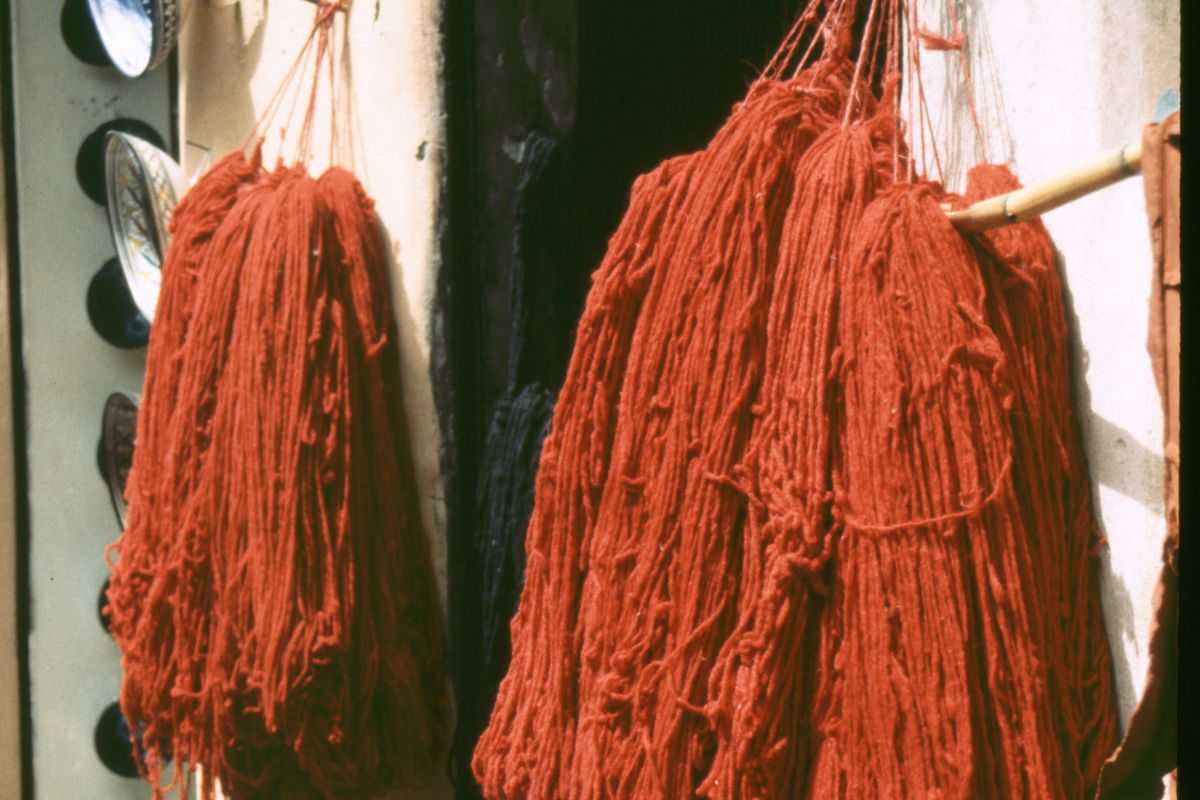
    Where color is added, historical and traditional practice draws on a specific, recurring set of plant materials, documented consistently across multiple independent sources: madder root, producing reds and terracottas; indigo, producing blues; saffron and pomegranate rind, producing yellows and golds; henna, producing reddish-browns; and walnut shell or hull, producing dark browns and blacks. This is the same palette named directly, with sources attributed, in this site's own Taznakht guide, where Africanews's reporting specifically named henna, pomegranate peel, saffron, and indigo leaves as the cooperative's dye materials.

    Natural dyes produce color with real variation built in: no two dye batches land on exactly the same shade, since the result depends on the specific plant material, water, mordant, and even the season it was prepared in. That's part of why natural-dyed pieces develop the muted, complex, slightly uneven color character collectors associate with older or traditionally made rugs, as opposed to the flatter uniformity of a modern synthetic-dye batch.

    Synthetic dyes and why modern production leans on them

    Modern Moroccan rug production increasingly uses synthetic dyes, which produce brighter, more saturated, and more consistent color than natural dyeing allows, a real practical advantage for a producer trying to match a specific shade reliably across a production run. Some of the brighter, more electric colors seen in contemporary Azilal and Boujad production reflect this shift toward synthetic dye availability, alongside older natural-dye traditions that continue in parallel rather than having been fully replaced by it.

    Neither natural nor synthetic dye is inherently "more authentic" on its own. Synthetic dyes have been in use in various forms for well over a century in many textile traditions worldwide, and a rug's genuine hand-knotted or handwoven construction is a separate question from which dye technology colored its yarn. Treating synthetic dye as automatic proof of a fake, or natural dye as automatic proof of authenticity, is exactly the kind of oversimplified claim this site avoids making.

    Quick reference: common natural dye sources

    Dye source Color produced
    Madder root Red, terracotta
    Indigo Blue
    Saffron Yellow, gold
    Pomegranate rind Yellow, gold, tan
    Henna Reddish-brown
    Walnut shell/hull Dark brown, black

    This table reflects what plant material is documented to produce which color family in traditional dyeing practice generally. It is not a claim about the specific dye used on any individual rug, which would require asking the seller or, ideally, having documentation from the maker.

    Color also changes over time, and that's not a defect

    A rug's color the day it's finished is not necessarily its color a decade later. Natural dyes in particular are more light-reactive than most synthetic equivalents, and gradual fading or mellowing with sun exposure and handling is part of how a natural-dyed piece is expected to age, contributing to the muted "vintage" look collectors often prize. That's a genuinely different situation from a colorfastness defect or damage, though telling the two apart in a specific piece is a hands-on question this guide won't attempt to settle from a description alone.

    Why this guide won't tell you what a color "means"

    You will find plenty of content elsewhere asserting that a specific color carries a fixed symbolic meaning, that yellow "symbolizes joy," or red "symbolizes life," stated as settled fact with no source attached. This guide won't repeat those claims here. Symbol and color meaning in Amazigh weaving is a genuinely contested area: the same seller pages that assert confident color meanings are, in this site's own research for its symbolism cluster, often the only pages making the claim at all, with no museum, academic, or named cultural source behind it.

    Where a specific source can support a specific claim, as with the akhnif's documented motif, discussed in the akhnif guide, this site states it and names the source. For general color-in-rugs claims of the kind repeated across seller sites, no comparable sourcing was found in this guide's research, so none is asserted here as settled fact. If you've read elsewhere that a color in your rug "means" something specific, treat that as a claim from whoever told you, not a documented fact this site can confirm.

    How color connects to the styles already covered on this site

    Color is one of the fastest ways to narrow down which named style you're looking at, alongside pattern and density covered in how to identify a Moroccan rug from a photo. An undyed cream-and-black field points toward the Middle Atlas pile styles; warm plant-dyed reds and golds point toward southern traditions like Taznakht; bright, saturated color in a dense field points toward Azilal or Boujad; and an unusual palette of aubergine, mauve, and ochre points toward the underserved Aït Bou Ichaouen / Talsint tradition. Color alone won't settle an identification, but combined with pattern and construction, it's a genuinely useful signal.

    FAQ

    What determines a Moroccan rug's color?
    Three things: the natural tone of undyed wool, traditional plant-based dyes, and modern synthetic dyes. There's no single fixed factor, and no fixed symbolic code behind it.

    What plant materials were traditionally used to dye Moroccan rugs?
    Documented sources name madder root (red/terracotta), indigo (blue), saffron and pomegranate rind (yellow/gold), henna (reddish-brown), and walnut shell (dark brown/black).

    Does a specific color mean something in Moroccan rug weaving?
    This guide could not find a credible, named non-commercial source confirming fixed color meanings and will not repeat unsourced claims found on seller sites as settled fact. Where a specific documented meaning exists, as with the akhnif's motif, it is attributed to its actual source.

    Are natural-dyed rugs more authentic than synthetic-dyed ones?
    No. Dye type is a separate question from whether a rug is genuinely hand-knotted or handwoven. Both natural and synthetic dyes appear in genuine traditional production, and neither one alone proves or disproves authenticity.

    Can I tell which named style a rug is just from its color?
    Color is a useful clue, especially combined with pattern density and construction, but it isn't decisive on its own. See how to identify a Moroccan rug from a photo for the fuller identification approach.

  • How to Identify a Moroccan Rug From a Photo

    How to Identify a Moroccan Rug From a Photo

    A photo can narrow down which named Moroccan style you're likely looking at, and can flag some obvious signs a rug isn't hand-knotted at all. What a photo cannot do is authenticate a specific rug: confirm its exact age, region, or maker with certainty. This site's own Disclaimer says the same thing about hands-on inspection: individual-rug authentication isn't something a guide can do from a distance, and a photo is an even thinner basis than an in-person look. What follows is what to actually check in the photos you have, or can request, without pretending a checklist settles more than it does.

    What the back of the rug shows, if you can get a photo of it

    If a listing includes a photo of the reverse side, look there first. Hand-knotted rugs show individual knots on the back, with natural, small irregularities in spacing and tension. No two knots are perfectly identical, because a person tied each one by hand. A machine-made rug, by contrast, typically shows a uniform, mesh-like backing with none of that hand-tied variation, since it was produced by a loom running a repeating mechanical pattern rather than a weaver's hands.

    Requesting a back-of-rug photo is a reasonable, low-friction ask of any seller. A seller who has nothing to hide about a piece's construction should be able to provide one without objection; one who resists or has only front-facing photos available is giving you less to work with, which is itself useful information.

    Wool, patina, and asymmetry: what a photo can and can't tell you

    Genuine Moroccan tribal rugs are overwhelmingly wool, sometimes with cotton in the warp threads specifically. In a photo, wool tends to show a certain depth and slight sheen that's hard to fake convincingly, though this is a soft, experience-based read rather than a definitive test. It gets easier to judge the more genuine pieces you've actually seen, and harder to trust from a single low-resolution photo of an unfamiliar piece.

    Vintage pieces often show a natural patina: a soft, uneven sheen and slightly muted coloring that develops from age and handling, rather than the flat, uniform coloring of a new synthetic-dye reproduction. Genuine handmade rugs also typically show slight asymmetry: a border that isn't perfectly even, a motif that shifts slightly across the field, which is a normal, expected feature of hand weaving, not a flaw. A rug that looks suspiciously perfect, with mechanically even borders and identical repeating motifs, is worth a second look, though "looks a little too perfect" is a prompt to ask more questions, not proof of anything on its own.

    Matching the pattern to a named style

    Once you've ruled out the more obvious "not handmade at all" signals, the next useful step is pattern-matching against the named styles this site already covers. An undyed ivory ground with sparse, dark geometric motifs points toward Beni Ourain or its denser relative Beni Mrirt. Bright, freehand, almost sketch-like patterns on a lighter ground point toward Azilal. Warm pinks, magentas, and reds in a denser weave point toward Boujad. A flat, patterned rug with the design visible on both sides points toward Zanafi or Moroccan kilim/hanbel. If none of those match and you're seeing an unusual, saturated palette of aubergine, mauve, tangerine, and ochre in a dense pattern, check Aït Bou Ichaouen or Talsint instead. Working through this site's own style pages this way will get you closer to a likely match than a generic "Moroccan rug" search will.

    Other signs a listing photo can reveal

    A few additional checks are worth running through before you get to the point of asking the seller anything:

    • Fringe. Genuine hand-knotted rugs usually have fringe that is a continuation of the warp threads running through the body of the rug, not a separate strip stitched onto the edge afterward. A fringe that looks glued, serged, or obviously sewn on as a distinct trim is a stronger giveaway of a machine-made reproduction than almost anything else visible in a photo.
    • Print versus weave. A genuinely woven pattern has texture and slight color variation within each motif, visible even at a moderate zoom. A printed pattern on a flat or minimally textured backing (common in cheaper decorative "Moroccan-style" rugs sold by mainstream furniture and decor retailers) tends to look flatter and more uniformly colored than a woven equivalent.
    • The listing's own language. Terms like "Moroccan-inspired," "Moroccan-style," or "Beni Ourain-style" are often used honestly by retailers selling machine-made reproductions, and are worth reading carefully rather than skimming past. They're a different product category from a hand-knotted piece attributed to an actual weaving tradition, priced and made very differently.

    None of these checks is definitive alone, and a confident answer on all three still isn't the same as an expert appraisal. But together they narrow the range meaningfully before you ever have to ask the seller a direct question.

    What to ask the seller for, if the photo alone isn't enough

    • A photo of the back, for the knot-versus-mesh check above.
    • Origin information, even if it's general: region, cooperative, or dealer source, rather than just "Morocco."
    • Material confirmation: wool content specifically, and whether any synthetic fiber is blended in.
    • A close-up of the pile or weave texture, if the listing photo is low-resolution or heavily filtered, since both can obscure the details above.

    A seller who can answer these specifically is giving you real information to work with. A listing that stays vague on all of them after being asked isn't necessarily dishonest, but it is offering you less than what a well-documented piece could provide.

    What this guide cannot do

    This guide, and any photo-based checklist, has real limits. It cannot confirm a specific rug's age. No photo-based method reliably does that, and this site does not publish age estimates it cannot support with a named source. It cannot confirm which specific tribe or cooperative made an individual piece, even when a general style is identifiable, since named attribution requires documentation this site has repeatedly noted is often missing even from sellers themselves. And it cannot substitute for an in-person, expert appraisal on a purchase where that level of certainty genuinely matters to you. Photos and questions narrow the range of likely answers; they don't settle them.

    FAQ

    Can I tell if a Moroccan rug is real from a photo alone?
    Partially. A photo can flag some signs a rug is machine-made rather than hand-knotted, and can help match it to a likely named style. It cannot authenticate a specific piece's age, region, or maker with certainty.

    What's the single most useful photo to ask a seller for?
    A clear photo of the back of the rug. It's the most reliable way to check for individual hand-tied knots versus a uniform machine-made mesh backing.

    Does asymmetry in the pattern mean a rug is fake?
    No, the opposite, generally. Slight asymmetry is a normal, expected feature of genuine hand weaving. A pattern that's mechanically perfect and identically repeating is more worth questioning than one with natural variation.

    How do I know which named style I'm looking at?
    Compare the palette and pattern density against this site's style pages, undyed and sparse points toward Beni Ourain, bright and freehand points toward Azilal, pink and dense points toward Boujad, and so on. See the full Moroccan rug styles guide for the complete list.

    Should I buy a rug based on photos alone, without an in-person look or expert opinion?
    For a significant purchase, that's a real risk this guide won't talk you out of taking seriously. Photos and seller questions reduce uncertainty; they don't eliminate it, and this site's own Disclaimer is explicit that it does not offer individual-rug authentication.

  • Flatweave vs Pile Rug: Which Moroccan Style Fits

    Flatweave vs Pile Rug: Which Moroccan Style Fits

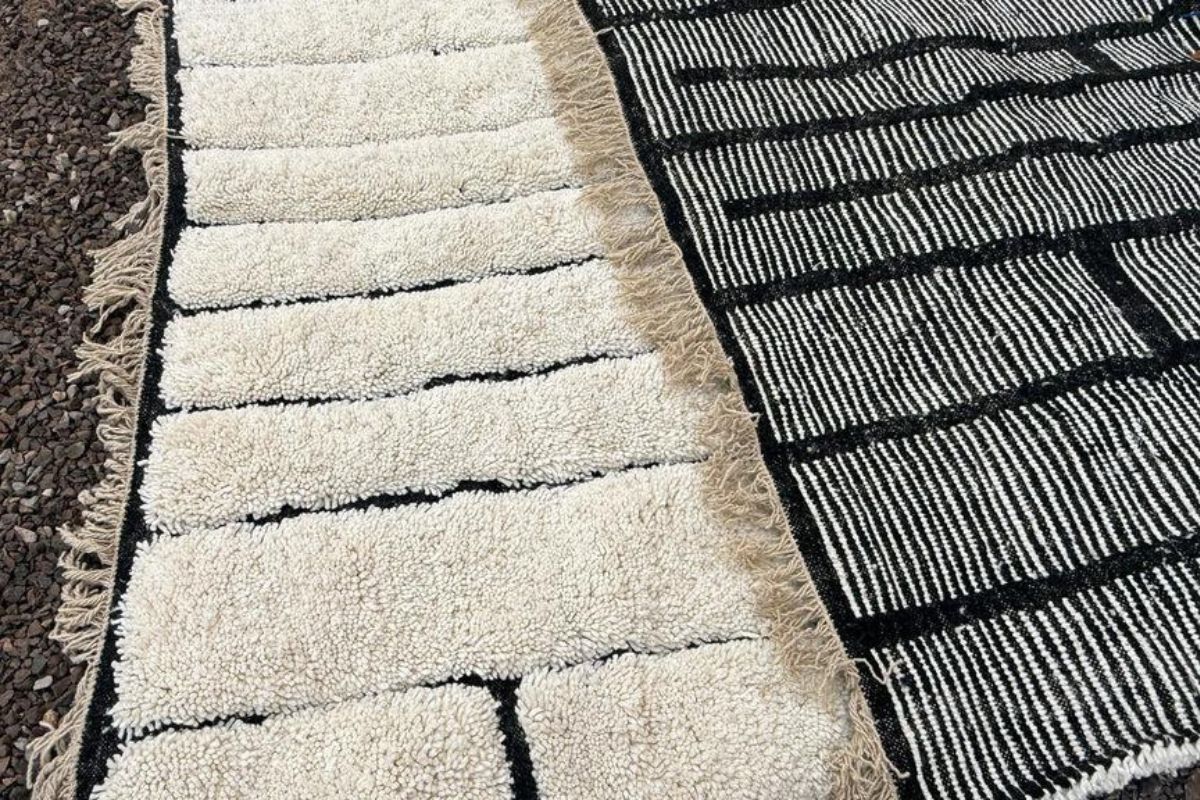
    If you're choosing between a plush style like Beni Ourain and a flat one like Zanafi or a Moroccan kilim, the underlying question is construction, not just look. Flatweave rugs are thin, firm, and low-shedding, which suits high-traffic areas, hallways, dining rooms, and anywhere furniture needs to move freely or a door needs clearance. Pile rugs are thicker and softer, with vertical yarn that adds cushioning and sound absorption, which suits living rooms, bedrooms, and spaces where comfort underfoot matters more than low-profile practicality. Moroccan weaving produces genuine, distinct styles in both categories. This isn't a compromise choice.

    Quick comparison

    Flatweave Pile
    Thickness Thin, flat Thick, raised surface
    Feel underfoot Firm Soft, cushioned
    Shedding Minimal Noticeable, especially when new
    Best rooms Hallways, kitchens, dining rooms, stairs Living rooms, bedrooms
    Example Moroccan styles Zanafi, Moroccan kilim/hanbel, Boucherouite Beni Ourain, Beni Mrirt, Beni Mguild, Azilal, Boujad
    Reads on both sides? Often, yes No, pile faces one direction

    What "pile" actually means, and which Moroccan styles are pile

    A pile rug is built with vertical yarn, the pile, standing up from a woven backing, either left as loops or cut, giving the surface height, softness, and texture you can run a hand through. That construction is what makes a pile rug feel warm and cushioned underfoot, but it also means more surface area to trap dust and shed loose fiber, especially when new.

    On this site, the pile family includes the Middle Atlas styles built around plush wool: Beni Ourain, Beni Mrirt, and Beni Mguild, along with the denser, more colorful pile traditions like Azilal and Boujad. These are the rugs people picture when they imagine a thick, soft Moroccan rug underfoot in a photo, the ones that read as substantial the moment you step on them.

    What "flatweave" actually means, and which Moroccan styles are flatweave

    A flatweave rug has no raised pile at all. The warp and weft yarns are woven tightly together into a flat, thin surface, with the pattern visible on both the front and often the back of the piece. That construction produces a thinner, firmer, more durable-underfoot rug that lies flatter, wears differently than a pile rug, and generally sheds far less because there's no loose vertical fiber to begin with.

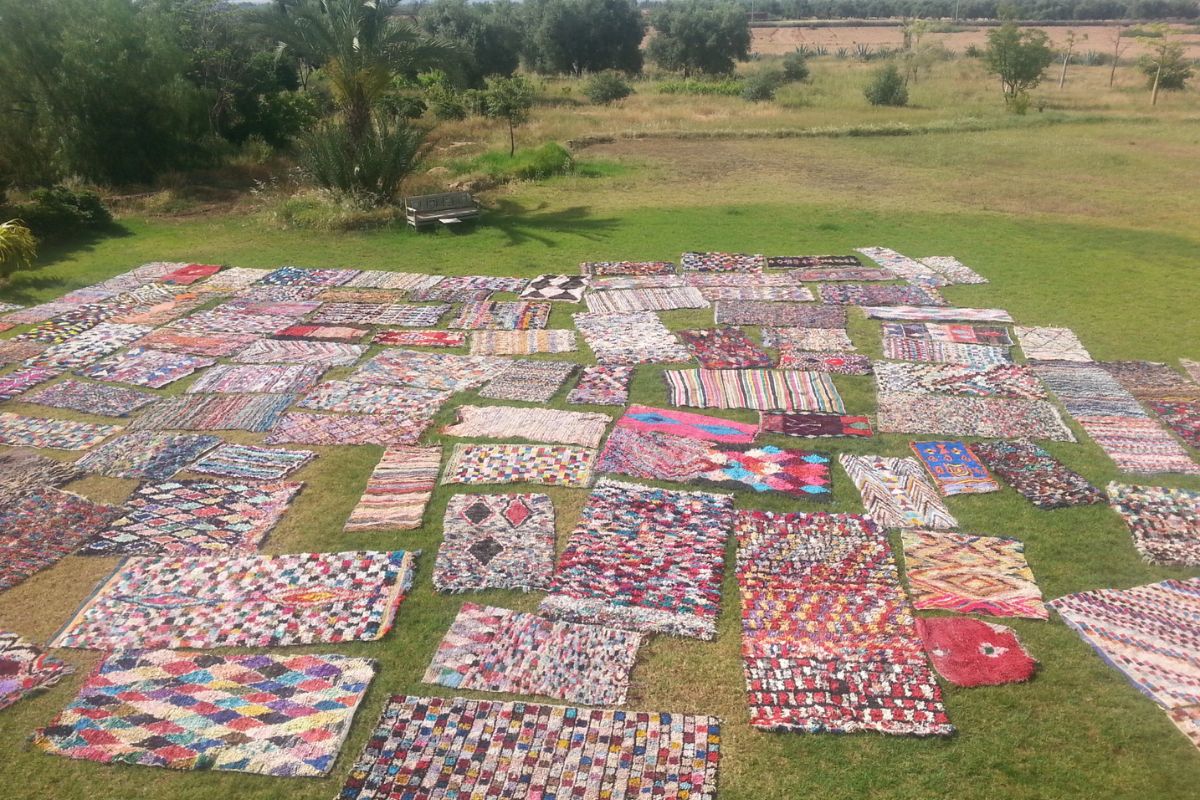
    Zanafi rugs, reversible flatweaves with a finished look on both sides, sit squarely in this category, as does the broader Moroccan kilim and hanbel family. Boucherouite rugs, the rag-weave style made from recycled textile scraps, are also generally flatwoven, which is part of why they can incorporate such varied, reused materials in the first place. A knotted pile construction would demand a much more uniform yarn supply than a rag weave does.

    Room-by-room fit

    Hallways, entryways, and stairs. A flatweave's low profile and durability make it the more practical choice anywhere a rug needs to withstand frequent foot traffic without bunching under a door or catching a shoe. A thick pile rug in a narrow, high-traffic hallway will show wear faster and can become a trip hazard if it isn't properly secured.

    Kitchens and dining rooms. Flatweave again, for the same reasons: easier to keep clean underfoot, and chair legs move across a flat surface more easily than across a deep pile, which matters directly under a dining table.

    Living rooms and bedrooms. This is where pile earns its keep: the comfort, warmth, and sound-dampening qualities of a plush Middle Atlas style are exactly what these rooms are for. A living room built around lounging on or near the floor, or a bedroom where bare feet hit the rug first thing in the morning, is the natural home for a Beni Ourain or Beni Mguild.

    Home offices and casual spaces. Either can work, depending on whether a rolling chair is involved. A flatweave handles a desk chair's wheels far better than a deep pile does; a low-pile option is a reasonable middle ground if comfort matters more than chair mobility.

    The middle ground: mixed-technique weaves

    Not every Moroccan weaving fits neatly into one category. Glaoui rugs combine flat, pile, and fringe techniques within a single piece, which is worth knowing if you've found one and are trying to judge how it will behave underfoot: parts of it will perform more like a flatweave, and parts more like a pile rug, within the same physical object. That's a genuinely different profile from either pure category, and one more reason "flatweave or pile" is a useful starting question rather than a rigid binary once you're looking at a specific named tradition.

    Spotting the difference in a photo

    Even without touching the rug, construction is often visible in a decent listing photo. A pile rug shows visible height and shadow along the surface, with individual tufts or a clearly textured field; a flatweave reads as flat and graphic in a photo, with the pattern rendered in solid blocks of color rather than a soft, textured surface. If a listing shows the back of the rug, that's an even stronger tell: a flatweave's pattern is usually visible, mirrored or near-identical, on the reverse side, while a pile rug's back shows the knot structure rather than the front-facing pattern itself. This is one of the more reliable checks available from a photo alone, compared to some of the harder authenticity questions covered in how to identify a Moroccan rug from a photo.

    What this doesn't determine

    Construction type says nothing about a rug's age, origin, or authenticity: those are separate questions covered on the individual style pages. A flatweave isn't automatically older or newer, more or less authentic, than a pile rug; it's a different, equally legitimate construction technique with its own named traditions behind it. Nor does construction type tell you whether a specific piece is hand-knotted or hand-woven at all. A machine-made reproduction can imitate the look of either category, which is a separate check covered elsewhere on this site.

    FAQ

    Is a flatweave rug lower quality than a pile rug?
    No. They're different constructions with different strengths, not a quality hierarchy. A well-made flatweave and a well-made pile rug are both genuine, skilled hand-weaving, suited to different practical uses.

    Which is better for a room with pets or kids?
    Flatweave generally holds up better to heavy, frequent use and sheds less, which matters in high-activity rooms. Pile rugs can still work in these spaces; they just need more maintenance and are more forgiving in lower-traffic rooms.

    Do flatweave Moroccan rugs shed less than pile ones?
    Generally yes, because there's no loose vertical pile fiber to shed in the first place. New pile rugs in particular can shed noticeably at first.

    Can a Moroccan rug be both pile and flatweave?
    Yes, Glaoui rugs are a documented mixed-technique tradition combining flat, pile, and fringe sections within one piece.

    Does construction type tell me anything about a rug's age or authenticity?
    No. Pile and flatweave are both long-standing, legitimate construction techniques across Moroccan weaving traditions. Neither one is inherently older, newer, more, or less authentic than the other.

  • Moroccan vs Persian vs Turkish Rugs Compared

    Moroccan vs Persian vs Turkish Rugs Compared

    Browsing a general "oriental rug" or "vintage rug" category and can't tell which broad tradition you're looking at? As a rough, non-absolute test: Moroccan rugs tend toward abstract or geometric motifs with a looser, more relaxed knot structure and an organic, slightly rustic texture; Persian rugs favor curvilinear, floral, or medallion-based designs with dense, small asymmetrical knots; Turkish rugs favor geometric medallions and repeating patterns using a symmetrical, double-wrapped knot. These are trade generalizations about three enormously varied traditions, not fixed rules every individual piece follows, but they're a genuinely useful starting orientation.

    Design: geometric vs. floral vs. medallion

    Moroccan rugs, the family this site covers in depth, from minimalist Beni Ourain to colorful Azilal and Boujad, lean toward abstract, geometric, or freehand tribal motifs, often with visible asymmetry that reads as intentional rather than a flaw. Persian rugs are generally associated with more intricate, curvilinear design work: florals, vines, and central medallions rendered with fine detail. Turkish rugs sit somewhere in between stylistically, more likely than Persian work to foreground geometric shapes (diamonds, stars, hexagons) but still frequently built around a central medallion or repeating floral border, rather than the freer, more abstract fields typical of Moroccan tribal weaving.

    None of these design tendencies are absolute. Persian weaving traditions include plenty of tribal, geometric work (Gabbeh and various nomadic Persian traditions, for instance, look far more abstract than a fine Isfahan or Tabriz piece), and Moroccan weaving includes some more structured, symmetrical traditions alongside its freer tribal styles. Treat "geometric means Moroccan" as a starting heuristic, not a rule that overrides everything else you can see in a piece.

    Knot technique: three different structures

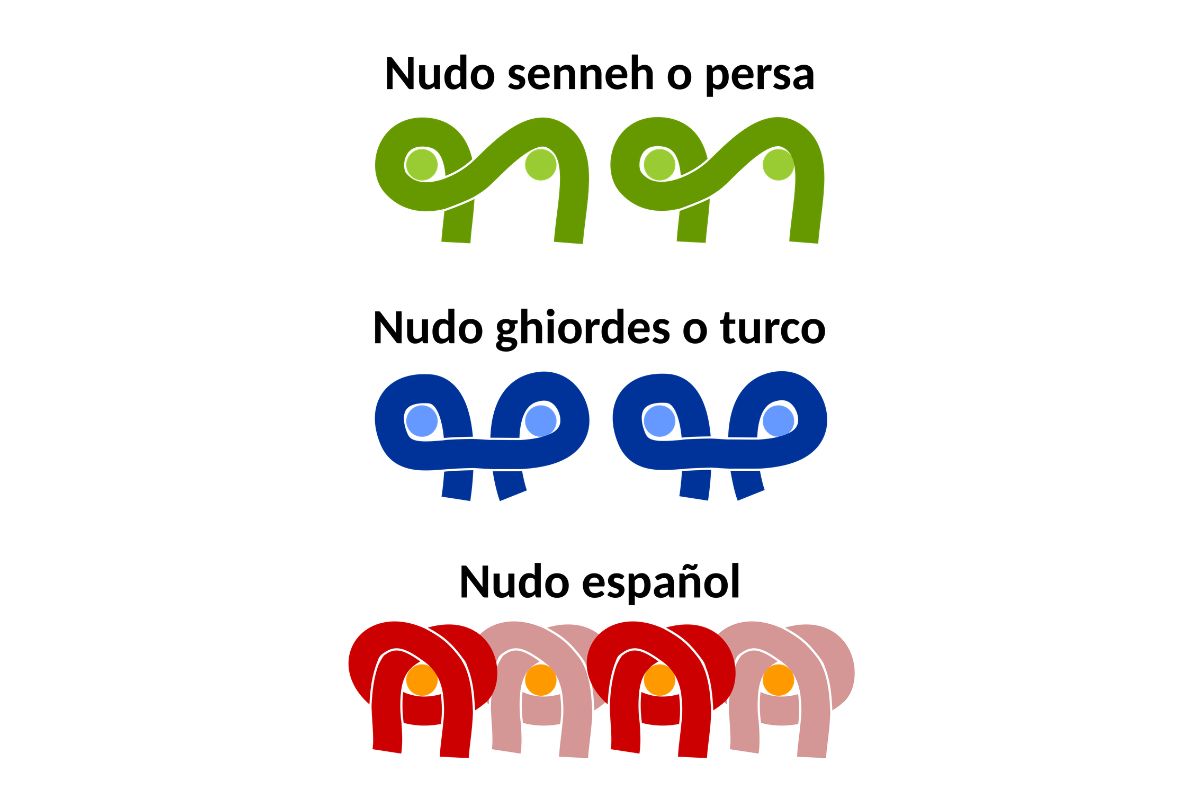
    This is where the traditions genuinely diverge on a technical level, not just a stylistic one. Persian weaving is closely associated with the asymmetrical knot, sometimes called the Persian or Senneh knot, which wraps around one warp thread and loops loosely around the adjacent one, allowing weavers to pack knots more densely and produce finer detail. Turkish weaving is associated with the symmetrical, double-wrapped knot, the Turkish or Ghiordes knot, where the yarn wraps fully around two adjacent warp threads, producing a slightly bulkier, more secure knot. Moroccan tribal weaving, by contrast, is generally described as using a looser, less rigidly uniform knotting structure than either of those two traditions, which is part of what gives finished Moroccan rugs their characteristic soft, organic, slightly irregular texture rather than the tight uniformity of a fine Persian or Turkish piece.

    None of this is something you can reliably verify from a listing photo alone. Knot structure is a back-of-the-rug, hands-on question, closer to what's covered in how to identify a Moroccan rug from a photo, but it's useful to know these are real, named, technically distinct construction methods, not just marketing language for three interchangeable products.

    Material: correcting a claim that gets repeated wrong

    Here's a specific inaccuracy worth naming directly, because it shows up across a lot of general rug-comparison content: several sources describe Persian rugs as "typically made from silk." That's not accurate. The overwhelming majority of Persian rugs, historically and today, are wool; silk is used in a specific minority of fine, high-end production (some Qum and Isfahan pieces, for example), not as the material baseline for the tradition as a whole. A buyer who assumes "Persian equals silk" is liable to either overpay for a wool piece expecting silk-level delicacy, or underestimate the fineness of a genuinely well-made wool Persian rug because it "isn't silk."

    Turkish rugs are similarly primarily wool, with silk used in specific fine production. Moroccan tribal rugs, the family this site covers, are essentially always wool. This site has not found silk used as a base material in any of the named Moroccan traditions covered here, which is one more reason "which one is silk" is the wrong question to be asking when sorting these three broad traditions apart.

    Why the general "oriental rug" label tells you less than it sounds like it does

    "Oriental rug" is a retail catch-all covering Persian, Turkish, Caucasian, Central Asian, and various other hand-knotted traditions, in the same loose way that "Berber rug" is a catch-all for several distinct Moroccan and Amazigh traditions (see what "Berber rug" actually means for that specific confusion). A listing that says only "vintage oriental rug" is telling you almost nothing about the actual origin, technique, or material of the piece. If a Moroccan rug ends up filed under a general "oriental rug" category, which happens on some marketplaces, the design and knot-structure signals above are what will actually help you sort it out, more than the category label itself.

    What to check on the specific listing in front of you

    • Design first. Abstract/geometric with visible asymmetry points toward Moroccan; fine curvilinear floral or medallion work points toward Persian; geometric medallion work with repeating borders points toward Turkish, as a starting orientation, not a verdict.
    • Ask about material specifically, rather than assuming from the region named. Don't assume "Persian" means silk, or that a wool Persian rug is somehow lesser for being wool.
    • Ask for a photo of the back, if construction detail matters to your decision: that's the more reliable way to assess knot density and structure than a front-facing listing photo alone.
    • Treat regional and tradition names as a starting point, not a certainty, especially on older or unlabeled pieces where several traditions' visual and technical features can genuinely overlap.

    FAQ

    What's the main visual difference between Moroccan, Persian, and Turkish rugs?
    Moroccan rugs generally favor abstract, geometric tribal motifs; Persian rugs favor curvilinear floral and medallion designs; Turkish rugs favor geometric medallions and repeating patterns. These are general tendencies, not fixed rules for every piece.

    Are Persian rugs made of silk?
    Mostly no. The large majority of Persian rugs are wool. Silk is used in a specific minority of fine, high-end production and should be treated as a premium exception, not the material baseline for the tradition.

    What's the knot difference between Persian and Turkish rugs?
    Persian weaving is generally associated with the asymmetrical (Senneh) knot, which allows denser packing and finer detail. Turkish weaving is generally associated with the symmetrical, double-wrapped (Ghiordes) knot, which is slightly bulkier and more secure.

    Are Moroccan rugs the same as "oriental rugs"?
    "Oriental rug" is a broad retail category that can include Moroccan pieces alongside Persian, Turkish, Caucasian, and other traditions. It isn't a specific style, in the same way "Berber rug" isn't one specific Moroccan style either.

    Can I tell these three traditions apart from a listing photo alone?
    Design tendency is often visible in a photo. Knot structure generally isn't, without a clear photo of the rug's back. Neither check substitutes for asking the seller directly about origin and material.

    Is one of these three traditions better quality than the others?
    Not as a blanket rule. Each tradition spans a wide range of quality, from coarse everyday pieces to museum-grade work. A fine Persian rug and a well-made Moroccan tribal rug are excellent in different, tradition-specific ways rather than ranked against a single quality scale, and this guide won't manufacture a ranking that doesn't reflect that variation.

  • What Is a Berber Rug? The Word, and Its History

    What Is a Berber Rug? The Word, and Its History

    "Berber rug" is not one style. In a rug listing, it usually means one of several distinct named traditions grouped under a single, loosely used retail label: Beni Ourain, Azilal, Boujad, and others already covered on this site. The word "Berber" itself also has a contested history: it comes from an ancient exonym with roots meaning "foreigner" or "barbarian," and many Amazigh people and scholars reject it for that reason, preferring their own name for themselves, Amazigh. This guide uses both terms, and explains why.

    Where the word "Berber" comes from, and why it's contested

    "Berber" traces back to the Latin barbarus, itself from the Greek bárbaros, a term Greeks and Romans originally applied broadly to foreigners whose speech sounded unintelligible to them, later extended by Romans specifically to North African peoples encountered during Roman expansion into Numidia and Mauretania. That origin is documented in linguistic-anthropology sources including the Society for Linguistic Anthropology and Britannica's own entry on the Berber people.

    The word's baggage doesn't stop in antiquity. Its root is widely noted to overlap with, and sometimes be treated as equivalent to, the Arabic word for "barbarian," which is a live reason many Amazigh scholars and activists reject "Berber" as a pejorative label rather than a neutral ethnonym. There's also a more recent political layer: French colonial administration in 20th-century North Africa institutionalized "Berber" as an official administrative category, part of a broader colonial strategy that treated Amazigh and Arab populations as separate groups to be managed differently. That history is one more reason the term carries weight beyond its dictionary definition.

    Amazigh: the term the people use for themselves

    The people commonly labeled "Berber" from the outside use their own name for themselves: Imazighen (singular Amazigh). Linguistic sources gloss the term's root as meaning something close to "free people" or "noble free people", a self-description that stands in direct contrast to an exonym rooted in "foreigner" or "barbarian." Respecting that self-chosen name, rather than defaulting only to the externally imposed one, is a small but real editorial choice, and it's the reason every style page on this site introduces its subject as Amazigh weaving alongside the more commercially familiar "Berber" label.

    None of this means "Berber" is a slur that must never appear. It's the term most buyers will search and most sellers will use, which is exactly why a guide that only ever said "Amazigh" would be less useful to an actual shopper trying to make sense of a listing. The goal here isn't to police vocabulary; it's to explain what the word is actually doing so a reader isn't left assuming it's a neutral technical term with a single fixed meaning.

    What "Berber rug" means in a rug listing, in practice

    Walk into any rug retailer's site and "Berber rug" functions as a broad category header, not a specific product description. Underneath that heading you'll typically find named traditions this site treats as genuinely distinct: the minimalist, mostly-undyed Beni Ourain; the colorful, freehand Azilal; the pink-and-magenta Boujad; flatweaves like Zanafi or Moroccan kilim and hanbel; and others. These traditions differ in region, material, technique, and look. Collapsing all of them into one umbrella term is convenient for a retailer's navigation menu, but it hides real distinctions a buyer benefits from knowing.

    There's a parallel worth naming: the same collapsing happens with the word "Amazigh" itself in some usage, since it also refers to an enormously diverse set of peoples and languages across North Africa, not one homogenous group. "Berber rug" and "Amazigh weaving" both function, in casual use, as umbrella terms over real internal diversity. The difference is that one term's origin is external and contested, and the other is the term the people themselves use.

    What "Berber" doesn't tell you

    Because "Berber rug" is a retail catch-all, the word alone tells you almost nothing about region, era, dye type, or construction, the exact information a buyer usually actually wants. A listing that says only "vintage Berber rug" with no named style, no stated region, and no material detail is giving you less information than the trade actually has available for most of these traditions, several of which, like Taznakht, have real, citable, documented cooperative histories behind them. If a seller can't or won't go beyond "Berber rug" as a description, that's worth noting, not necessarily as a red flag, but as a prompt to ask for more.

    A different confusion: "Berber carpet" in flooring

    If you searched "Berber rug" and ended up reading about wall-to-wall carpet installation, you've run into a completely separate use of the word. In the US flooring trade, "Berber carpet" refers to a specific machine-made, loop-pile broadloom carpet style, sold by the roll for wall-to-wall installation, that took its name from a resemblance to the coarser texture of some Amazigh weaving but has no other connection to it. It's manufactured on entirely different equipment, sold through entirely different retail channels, and has nothing to do with an actual hand-knotted or handwoven Moroccan rug. This site covers hand-knotted wool rugs only, never wall-to-wall carpet of any kind. A loop-pile broadloom product and a hand-knotted rug are different objects with different care needs, a distinction worth keeping in mind if you ever compare cleaning advice between the two.

    If a search result or a home-improvement forum is discussing carpet padding, stretching, or wall-to-wall installation under the word "Berber," that's this unrelated flooring product, not anything covered on this site.

    How this site uses the two terms

    This site uses "Amazigh" as the primary term for the people and the weaving tradition, and uses "Berber" where it reflects how the trade and search terms actually work, because a reader searching "Berber rug" deserves an answer, not a lecture. Where a specific named style, region, or cooperative is known, this site uses that specific name rather than resting on either umbrella term. That's the same discipline applied across every style page here: name what's actually known, and say plainly when a broader label is standing in for something more specific.

    FAQ

    Is "Berber rug" a real rug style?
    No. It's a retail umbrella term covering multiple distinct named Moroccan and Amazigh weaving traditions, not a single defined style with consistent construction or origin.

    Why do some people object to the word "Berber"?
    Because it derives from an ancient exonym rooted in "foreigner" or "barbarian," and its root overlaps with the Arabic word for "barbarian." Many Amazigh scholars and activists consider it a pejorative label imposed from outside rather than a neutral name.

    What does "Amazigh" mean?
    It's the term the people themselves use, commonly glossed as "free people" or "noble free people," and is generally the preferred term over "Berber" in scholarly and activist usage.

    Should I stop using the word "Berber rug" when shopping?
    Not necessarily. It's the term most listings and search results actually use. This guide uses both terms for that reason, while being clear about the word's contested history and preferring named, specific styles over the umbrella label wherever possible.

    If a listing just says "Berber rug" with nothing else, what should I do?
    Ask the seller which specific tradition or region the piece is attributed to. See how to identify a Moroccan rug from a photo for what else to check before relying on a generic label alone.

  • Akhnif Morocco: The Amazigh Cape, Not a Rug

    Akhnif Morocco: The Amazigh Cape, Not a Rug

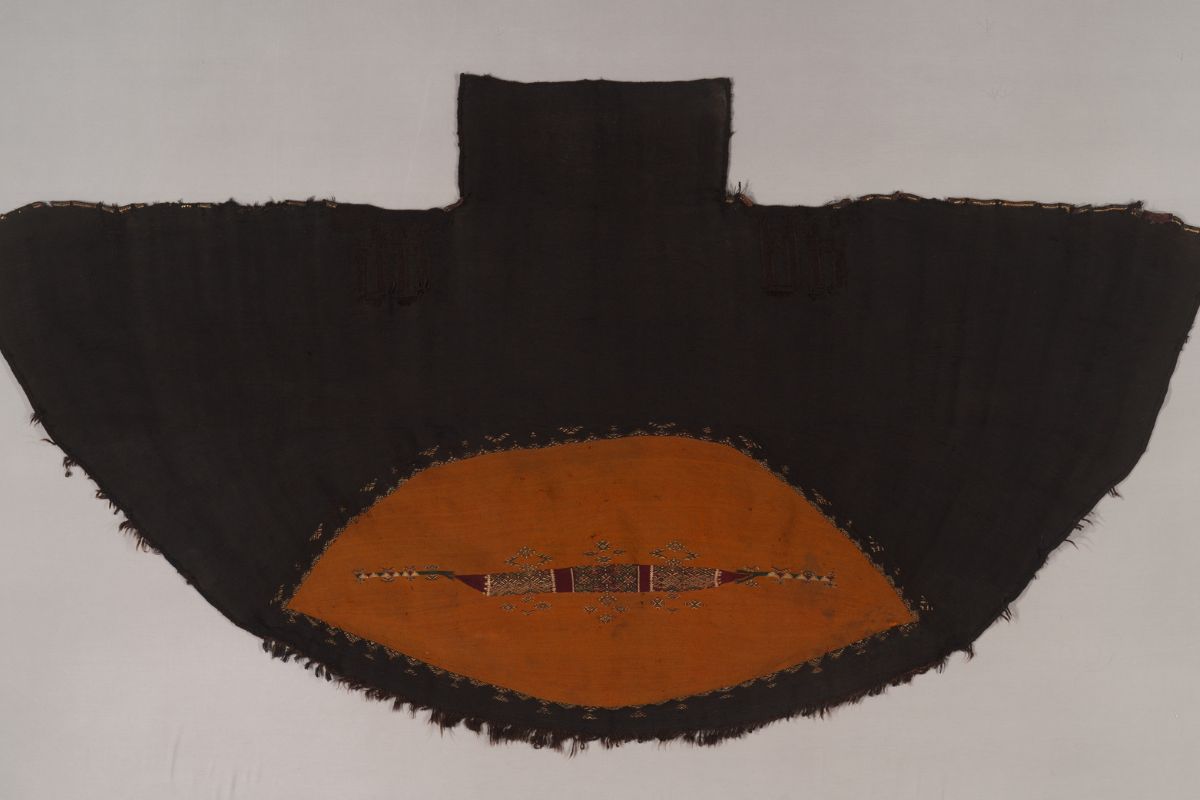
    An akhnif is a handwoven hooded cape, not a rug. It was made by Aït Ouaouzguite Amazigh women in southern Morocco on a wide vertical loom, woven entirely to shape starting upside-down from the hood, in wool mixed with goat hair that gives the finished cloak its dark, near-black ground. If you've seen "akhnif" attached to a textile listing or a museum object and assumed it was some kind of floor covering, it isn't. It's clothing, and understanding that distinction matters for reading Amazigh-textile listings generally, not just this one item.

    Not every Amazigh textile is a rug

    Every other style page on this site covers a floor rug: something knotted or woven flat, meant to be walked on. The akhnif breaks that pattern on purpose, because it's a useful reminder that Amazigh weaving traditions produced far more than rugs: clothing, blankets, and ceremonial textiles all came out of the same regional weaving knowledge, often made by the same communities. A seller or a collector database that files an akhnif alongside "Moroccan rugs" is filing it in the wrong category, even if the weaving technique and cultural context genuinely overlap.

    Unusually for this niche, the strongest sources on the akhnif are not rug dealers. They're museums and academic textile scholarship: the Art Institute of Chicago's own collection records, Smarthistory's dedicated essay on the akhnif, and a Textile Museum Journal article from The George Washington University's museum specifically reconstructing the historical akhnif of southern Morocco. That is a meaningfully different evidence base than most of what this site can cite for individual rug styles, and it lets this page state some facts with more confidence than usual.

    How it's woven

    The akhnif is woven entirely to shape on a wide vertical loom, starting upside-down from what becomes the hood. That is a genuinely demanding technical feat: the weaver has to control vertical warp tension and manage complex horizontal weft turns to build a curved shape into a flat weaving process, a skill Smarthistory's essay describes as reserved for the most experienced weavers. Once the main cloak was off the loom, male artisans, not the women who wove it, added the leather binding and other finishing details, a division of labor worth noting on its own, since it means the akhnif's production involved both women's and men's specialized work at different stages.

    The body of the cape is wool blended with goat hair, which is what produces its distinctive dark, near-black color, rather than the undyed ivory associated with a style like Beni Ourain or the bright plant-dyed range seen in a piece like a Taznakht rug.

    The motif on the back, and what it's said to mean

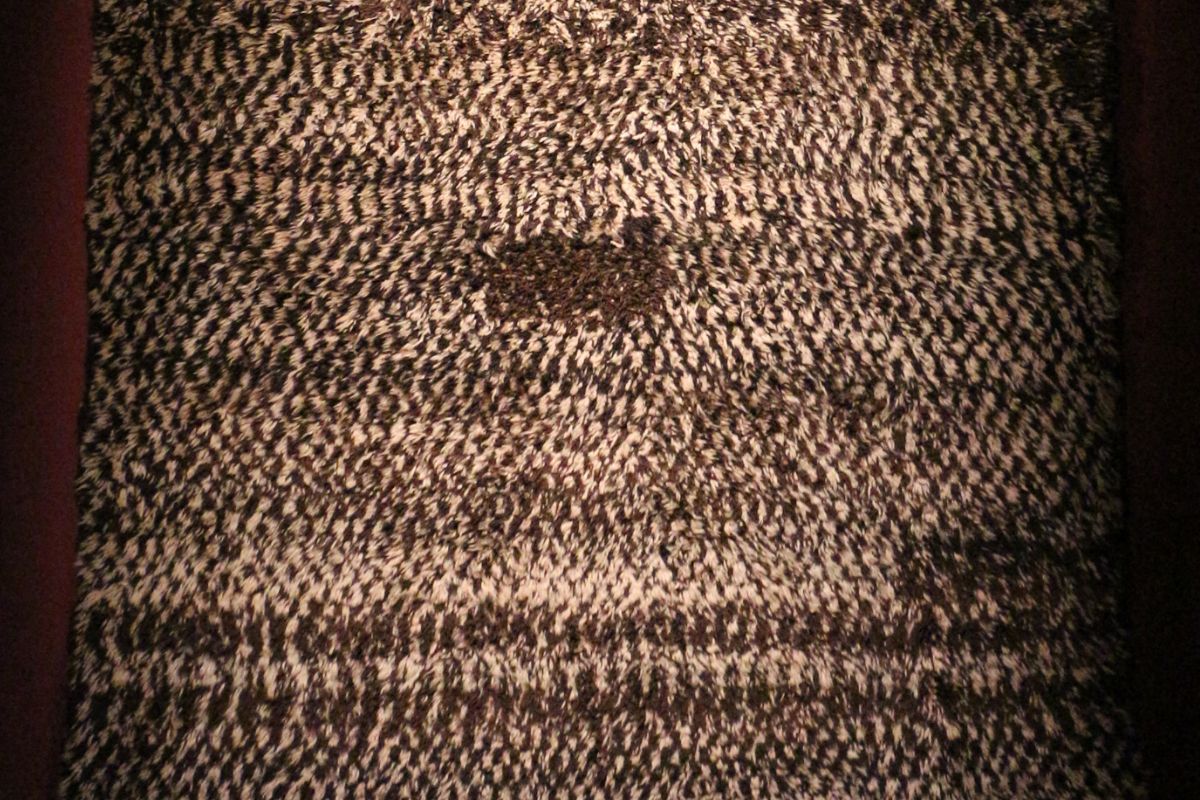
    Every akhnif carries a prominent motif on its back, usually a circular or diamond-centered design that dominates the garment visually. Smarthistory's essay names this motif irghis n-ukhnif, translating it as roughly "the eye" or "the red of the akhnif," and describes it as serving two roles at once: it was the garment's visual focal point, and it functioned as a protective sign centered over the wearer's back.

    That is a genuinely sourced symbolic reading, attributed to a specific academic essay, not a claim manufactured by a seller with a piece to move. This site is generally cautious about symbol-meaning claims for exactly that reason. Most "this pattern means X" statements found elsewhere in this niche trace to nobody in particular. Here, the source is named, which is why this page states the reading directly instead of hedging it into vagueness.

    Who wore it, and why it largely disappeared

    Akhnif capes were worn by men, and museum sourcing notes they were worn by both Muslim and Jewish men in the regions where the tradition was practiced, typically layered over a haik (a large wrapped cloth) or a jellaba (a hooded gown with sleeves). The akhnif functioned as an outer layer against cold, and its visual weight made it a garment of real social presence, not simply a practical wrap.

    Production of new akhnifs largely stopped by the early 20th century. Museum sourcing attributes this to straightforward economics: the amount of skilled labor the weave demanded, combined with the cost of the wool involved, made the garment increasingly impractical to keep producing as available time, materials, and demand shifted. What survives today is largely older stock in collections and the antiques market, rather than an ongoing living production the way some rug traditions on this site still are.

    Where to see real, documented examples

    Because the akhnif is one of the most widely collected Amazigh textiles, documented examples sit in major public collections rather than only in private dealer inventories: the Art Institute of Chicago, the Peabody Museum of Archaeology and Ethnology at Harvard, the Metropolitan Museum, the Musée du Quai Branly in Paris, the Newark Museum, and the National Museum of World Cultures in the Netherlands all hold pieces. For a reader who wants to see a documented, provenanced example rather than a dealer photo, a museum collection record is the more reliable starting point.

    Why this matters for reading other listings

    If you encounter a Moroccan or Amazigh textile that clearly isn't a floor rug (a heavy woven cape, a ceremonial cloth, a blanket with a similar weaving character), it may well belong to this same broader craft tradition without being a rug at all. The weaving skill, the wool sourcing, and often the same regional or family lineages produced multiple kinds of textiles, not just carpets. A seller who describes every Amazigh textile they carry as a "rug" for search-engine convenience is flattening a genuinely wider craft into one product category, and a reader who only ever searches "Moroccan rug" may simply never encounter pieces like the akhnif at all. Treating "Moroccan rug" and "Moroccan weaving" as interchangeable terms, the way some general decor content does, misses real distinctions that matter both for accurate identification and for understanding the actual scope of Amazigh textile craft. See what "Berber rug" actually means for more on how loosely that broader terminology gets used in the trade.

    FAQ

    What is an akhnif?
    A handwoven hooded cape made by Aït Ouaouzguite Amazigh women in southern Morocco, woven to shape on a vertical loom from wool mixed with goat hair. It is a garment, not a rug.

    What does the motif on an akhnif mean?
    Smarthistory's essay on the akhnif names the motif irghis n-ukhnif, translating it as "the eye" or "the red of the akhnif," and describes it as both the garment's visual focus and a protective sign. That attribution is to the essay specifically, not to unnamed tradition.

    Who wore an akhnif?
    Men, layered over a haik or jellaba. Museum sourcing notes it was worn by both Muslim and Jewish men in the regions where the weaving tradition was practiced.

    Why did akhnif production largely stop?
    Museum sourcing attributes the decline, by the early 20th century, to the heavy skilled labor the weave required combined with the cost of the wool, making it increasingly impractical to keep producing at scale.

    Where can I see a real akhnif rather than a dealer photo?
    Documented examples are held by the Art Institute of Chicago, the Peabody Museum at Harvard, the Metropolitan Museum, the Musée du Quai Branly, the Newark Museum, and the National Museum of World Cultures, among others.